
About
What this site is, and what it refuses to be
Doubts, fears, faith questions and old loyalties before a second marriage — described honestly, side by side, without verdicts, readiness tests or scripts.
What this site claims, and what it does not
What this site claims
What it does not
The order of the columns is layout, not ranking — the same rule that governs every side-by-side block on this site.
Who writes this
I am on the second-marriage side of these questions rather than the professional one. I have signed a register twice, and the second time I did it quietly, in ordinary clothes, with the particular self-consciousness of someone who has done this before and is not sure she is allowed to look happy about it. Nobody hands you a script for that. The first time there was a script for everything.
What I remember most from the beginning is how much of it was administrative and how little of that anybody warns you about. A calendar that is not only ours. A name that comes up in a text message on a Sunday morning and changes the temperature of a room. A child who is polite to me and does not owe me more than that. None of it was a crisis. All of it needed somewhere to be put, and the pages that came up when I searched either graded me or ruled on me.
Those are the questions I arrived with, and they are the ones this site answers — where a tradition actually stands and on what, what people usually feel at a given point instead of whether they should, and where a page has to stop because the next step belongs to a pastor or a therapist. I am not qualified to rule on anyone else's marriage, mine included. I am qualified to notice when a page is pretending to be.
Before
Asking whether you may marry again stops being a research question the moment it is yours. It arrives at night, in the middle of a sentence you decided not to say out loud, and it brings a second question underneath it: whether wanting this again makes you the person your first marriage said you were.
The turn
What I found when I went looking was mostly verdicts. Pages that told me what a tradition teaches without showing me what it reads. A test that scored whether I was ready. Advice about a former partner written as though she were an opponent. The plain version was missing: here is where the traditions actually stand and on what, here is what people usually feel at this point, and here is where a page has to stop and a pastor or a therapist begins.
Now
So that is what this site does, and it is my job to keep it doing only that. I decide which questions get a page, I read every page before it goes up, and I am the address for telling us a page is wrong. My name on an article means somebody is answerable for it — never that I am qualified to rule on your marriage. Nobody here is.
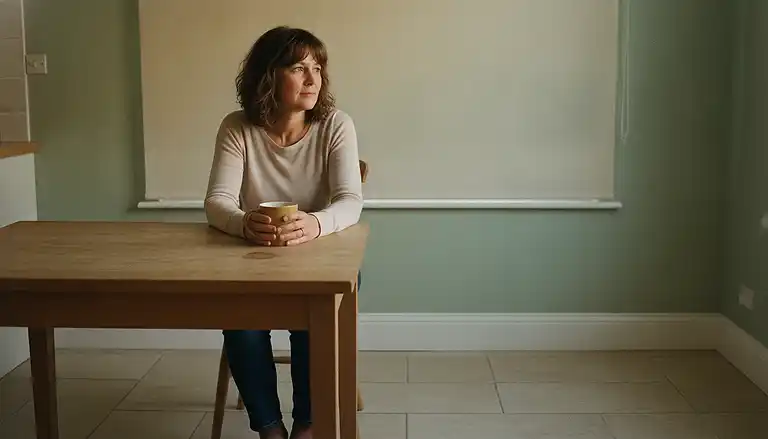
Nell Ashworth is a pen name, and it belongs to this site's editorial team rather than to a biography you could look up. The name exists so that a page has somebody answerable for it, and neither the name nor the portrait at the top of this page is meant to lend a page weight the text has not earned. There are no credentials behind it: nobody here is your pastor, your priest, your therapist or your lawyer, and no page is written as though it were. The portrait at the top of this page is not a photograph of a living person: it is an illustration, generated with an AI tool and labelled as one wherever it appears, and it is there to give the byline a face rather than to tell you whose. Drafting is AI-assisted and human-edited, every figure is traced to a named publisher before it appears, and if a sentence here is wrong the fastest route to fixing it is hello@secondmarriagehelp.com with the page address and the sentence you are disputing.
Pages about faith and about a failing marriage are exactly where a persuasive persona does the most damage. On a question like may I marry again, borrowed authority starts to function as permission — so the pages are built to stand on checkable things instead: named sources, plain description of behaviour, the exact population behind any figure. The byline says who is responsible for them. It does not say to defer to her.
Where a question needs a professional, the page says so and stops. We also do not put words in anyone's mouth: there are no interviews on this site, and no quotation here is attributed to a person who did not publish it.
How the pages are written
Every page starts from a question people actually type, taken from search data rather than from what we found interesting. The question decides the page; the page does not go looking for a question afterwards.
Drafting is AI-assisted and human-edited. We say that plainly because the alternative is letting you assume otherwise. What that means in practice: a model drafts against a brief, and a person is responsible for every claim that survives — the structure, the wording, what gets cut, and in particular every sentence that describes a tradition's position or somebody's behaviour. Nothing is published that a person has not read end to end.
Denominational positions are written from what the traditions themselves publish, and they are written to be recognisable to someone inside that tradition. When a position is contested inside a church rather than between churches, the page says that instead of picking the tidier version.
Illustrations are generated, and every one of them carries a visible label saying so — never presented as a photograph of a real household. Diagrams are drawn from what the page already argues in words; a diagram that introduced a new claim would be a claim that never went through editing. Neither ever contains a number.
Where the numbers come from
Mostly, they do not. This is a site about second marriages, which is a subject buried under confidently repeated statistics — the failure rate, the percentage who remarry, the odds for a household with stepchildren — and most of those figures travel with no year, no country and no definition of what was counted.
Our rule is mechanical rather than editorial: a build gate blocks any figure that is not in an approved list, and a figure only enters that list with a named publisher, a year, a working link and the population it describes. If a number cannot carry those four things, it does not appear — including when it would have made a paragraph land harder.
The practical consequence is visible on the page about the failure rate: it explains why the published figures disagree with one another instead of choosing one of them. What is currently approved is listed on the numbers page, and the sources behind it on the sources page.
If we have got something wrong
Tell us. Email hello@secondmarriagehelp.com or use the contact page, and if you can, include the page address and the sentence you are disputing — that alone turns a correction from a week of guessing into an afternoon.
What happens next: we check it against the source the page was written from. If the page is wrong, the sentence is changed and the change is dated, rather than quietly rewritten. If the page is right but unclear, that is still our problem and it still gets rewritten. If we disagree with you, we will say so and say why.
Corrections we consider most urgent, in this order: anything that misstates what a tradition teaches; anything that reads as advice about another person's children; anything that reads as a verdict where the page is supposed to describe. Full policy on the editorial page.
Where people usually start
Four sections, and nobody arrives carrying all four at once. Each one opens with a piece that frames the whole section rather than answering a single question.
- Faith and remarrying
What Christian traditions teach about divorce and remarriage, which texts they read, and why the same passages divide them — side by side, without a verdict.
Open this section
- The doubts
Cold feet before a second wedding, the fear of failing twice, comparing a new partner to an ex — described as the normal weather of remarrying, not as symptoms.
Open this section
- The ex factor
His ex-wife, her ex-husband, co-parenting calls and old loyalties: what former partners bring into a second marriage, and the boundaries couples set together.
Open this section
- When it strains
When a second marriage starts to strain — stepfamily tension, feeling second place, the quiet exhaustion — and where stepfamily counseling actually helps.
Open this section
Contact
hello@secondmarriagehelp.com, or the contact page. We read everything. We do not answer questions about a particular marriage, a particular annulment or a particular household — not because we are unwilling, but because answering them from the outside is the exact thing this site exists to avoid.
The letter
A letter when there is something worth saying
That did not go through, and the address was not saved. It is our fault, not yours — please try once more, or write to us directly.
What arrives
A short letter when a page here has genuinely changed, or when a question comes up often enough to be worth answering properly. Sometimes that is twice a month. Sometimes it is nothing for six weeks.
What never does
No countdowns, no course, no “are you ready to remarry” quiz, and nothing sold to you or about you. We do not pass the address on, and we do not track what you open.
One address, kept by us and nobody else. Unsubscribe link in every letter.