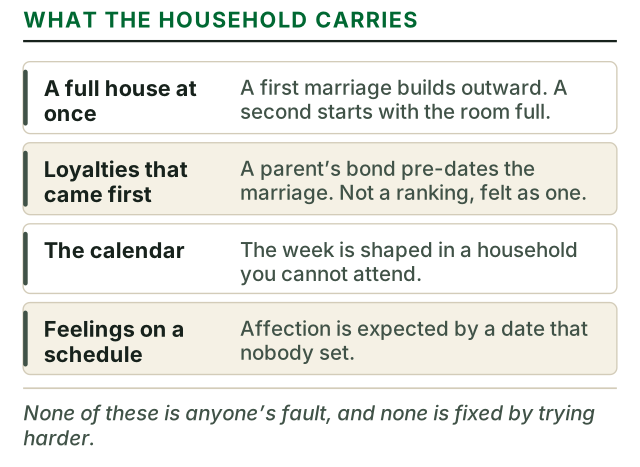
Second marriage strain is the weight a household carries when it is assembled rather than grown: two histories, sometimes two sets of children, a calendar that answers to another address, and adults who are expected to have arrived at feelings that in fact take years. Some seasons of it are heavier than anyone warns you about, and almost none of that weight is a sign that something has gone wrong.
This page is the frame for the section. It describes what the strain is usually made of, what tends to move it, and which page here covers which part. It stays on the emotional side throughout: what the weight feels like and what couples do with it.
Why is a second marriage often harder than the first?
Because it starts in the middle. A first marriage usually begins with two people and adds complications slowly; a second often begins with a full house, a set of existing loyalties, and a set of routines that were built without either partner’s new spouse in mind.
A stepfamily is a household in which at least one adult is parenting a child who is not theirs by birth, and its early years are commonly spent negotiating things that a first family never has to name out loud — bedtimes, tone, who may correct whom. For example, a rule about phones at dinner is a two-minute conversation in one household and a month-long negotiation in another, and the difference is not the rule.
The patterns people run into are described in blended family problems, and the specific ache of being the adult a child will not warm to is in when a stepchild doesn’t like me.
What does “feeling second place” actually describe?
It describes a partner watching their spouse’s attention arrive after somebody else’s, repeatedly, in ways that are individually reasonable and cumulatively exhausting. Each single instance is defensible, which is exactly what makes the feeling so hard to raise.
Feeling second place refers to that accumulation rather than to any one decision — the sense that in a conflict between your needs and a child’s, the outcome is already known before the conversation starts. Consider how differently the same cancelled evening lands the first time and the tenth. The page for that is feeling second place.
Why does the same argument keep coming back?
Because most of these arguments are not about the thing being argued about, and a settlement reached on the surface does not touch what is underneath. The bedtime gets solved; the heat moves.
A perpetual disagreement is one rooted in a difference between two people that will not be resolved by either of them being persuaded, and the research tradition on how couples handle exactly that kind of conflict runs from Gottman and Levenson’s work on marital processes through the observational coding described in Matthew Johnson’s account of specific-affect measurement. The subject of the argument is not the part under a couple’s control; the manner of it largely is. Imagine the same disagreement about a stepchild’s curfew held twice — once as a contest with a winner, once as two people describing what they are each afraid of.
Where the disagreement is specifically between the two adults about a child, when partners disagree is the page for it.
When do couples reach for stepfamily counseling?
Usually later than they meant to, and usually when a conversation has stopped resolving rather than when a crisis arrives. That timing is so common it is almost a pattern in itself.
Stepfamily counseling is family or couples therapy conducted by a practitioner who works specifically with stepfamilies, which matters because the standard couples frame can miss a household with a third adult in it who never enters the room. What it is and what a first session tends to look like is in stepfamily counseling.
Where this section stops
These pages name weight. They do not diagnose a household, they do not grade anyone’s parenting, and they cannot see whether what you are carrying is an ordinary hard season or something that needs more than description.
Take it to a family therapist if the strain is constant, if the same conflict has become the whole marriage, or if it is affecting your sleep, mood or ability to function. If a child seems frightened rather than resistant, or if any adult in the house is afraid of another, that is a different question from the ones answered here and it deserves someone trained to hear it.