Second marriage doubts are the doubts of someone who has already seen a marriage end. That is the whole difference. A first wedding is approached with hope and no data; a second is approached with hope and a complete case study, and the case study does not stay politely in the past while you plan the reception.
This page is the frame for the section rather than the advice. It sets out what these doubts are usually made of, which page here covers which one, and the line where a feeling stops being weather and starts being something a therapist should hear. Nothing here diagnoses, and nothing here scores you.
What are second marriage doubts usually made of?
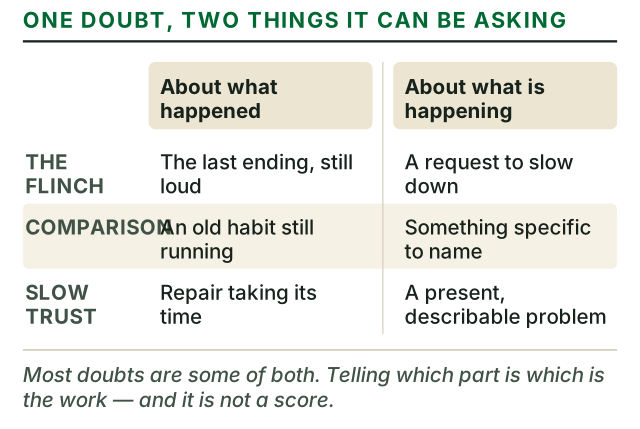
Mostly memory, working as prediction. The mind uses the material it has, and after a long marriage the material is that marriage: how it sounded before it went wrong, what the last good year felt like, which small silences turned out to matter.
Anticipatory grief is the rehearsal of a loss that has not happened, and it is the engine under a great deal of pre-wedding fear. It is why a perfectly good evening can end with a knot in the chest for no reason available to the person having it. For example, a partner who is simply tired on a Tuesday can be read, instantly and without any decision, as the opening move of something already survived once.
The specific fear of a repeat has its own page in the fear of failing twice, and the more general version — cold feet in the weeks before a second wedding — sits in the fear of marrying again.
Why does trust come back so slowly?
Because trust is rebuilt by accumulation rather than by decision, and accumulation takes the time it takes. Deciding to trust someone is a sentence; trusting them is a habit, and habits are built out of repetitions that cannot be hurried.
Trust after divorce refers to the slow return of the ordinary assumption that a partner’s behaviour is predictable and their account of it is true — not to a leap of faith made once and then defended. Attachment research describes this territory in its own vocabulary: the work that began with Hazan and Shaver’s account of romantic love as an attachment process treats adult closeness as a system that learns from what happened last time, which is exactly what makes a second marriage different from a first. Consider how much of the early strain of remarrying is simply a system doing that learning out loud.
The page on this is trust after divorce, and the identity question that often travels with it is in first wife, second wife.
Why is comparison so hard to stop?
Because comparison is the mind using the only long marriage it owns as a measuring stick, and there is no second stick available. It is not disloyalty and it is not a character fault.
Comparison is the involuntary matching of a present partner against a remembered one, and it becomes a problem not when it is thought but when it is spoken as instruction. Held privately it fades with use; said out loud as a rule imported from a household this person never lived in, it installs itself. Comparison also runs in both directions at once, which is why the page on it, being compared and comparing, refuses to pick a side to coach.
What actually helps with a doubt?
Saying it to the person it concerns, in the smallest true version, close to when it arrives. That is unglamorous and it is most of what works.
Naming a fear means describing what you are afraid of and what it does to you, rather than building a case about what your partner has proved. Imagine the difference between “you are doing what he did” and “when the room goes quiet I start waiting for something” — the second is answerable, and the first is a verdict the other person can only contest. Sue Johnson’s Hold Me Tight is built around conversations of that second kind, and is a reasonable place to read more about what they look like.
Where the doubt is really about the household rather than the couple — stepchildren, a partner stretched between two homes, the sense of coming second — that weight has its own section in when it strains.
Where this section stops
These pages describe ordinary difficulty. They do not assess your relationship, they do not tell you whether to marry, and they contain no readiness test, because a website cannot see your household and a score would only dress a guess in authority.
Take it to a therapist if the fear is constant rather than occasional, if it is affecting sleep, appetite or your ability to work, or if you have started managing your own behaviour around a person who is not in the room. If any part of you is frightened of your partner rather than of the situation, that is a different question from the ones answered here, and it deserves someone trained to hear it.