The fear of getting married again rarely announces itself on a bad day. It tends to arrive on a good one: an ordinary evening, a person you trust, and a cold drop in the stomach that says you have stood somewhere like this before, and you know how that ended.
Fear of getting married again is the response of a body to the approach of a commitment whose ending it has already survived, rather than a judgement about the person in front of you. People who feel it tend to read it as information about the relationship. It is closer to information about memory.
Is fear of getting married again normal?
Yes, and people who have been divorced describe it constantly. A first marriage is entered without proof that a marriage can end. A second one is not. The knowledge does not leave when the decree does.
That is why the fear so often has no content you can argue with. There is nothing wrong. There is no red flag anyone can name. Anticipatory fear is the reaction of a body that has learned what the end of a marriage costs, and it arrives at the approach of another one rather than at any evidence in front of it.
Fear is not a symptom to be cured before you are allowed to proceed. It is the ordinary weather of doing something a second time with your eyes open. Hazan and Shaver’s paper conceptualising romantic love as an attachment process describes adult partnerships in the terms used for the bonds people form much earlier in life. That is one of the traditions this kind of fear gets discussed in.
Two honest halves
Being scared to remarry: what it feels like, and what people do with it
The feeling and the response are separate things. Naming them apart tends to lower the volume on both.
What it feels like
Described by people in the middle of it
A dread that shows up around the paperwork, the ring, the date — not around the person.
A sense of being watched by your own history: that agreeing to this proves you learned nothing.
Sudden hyper-attention to small things your partner does that faintly resemble the old marriage.
Guilt about the fear itself, because the relationship is good and the fear feels like an insult to it.
What people do with it
Common responses, not prescriptions
Say it out loud to the partner, early and plainly, as a fear rather than as a doubt about them.
Separate the two questions: is this person wrong, or is the ceremony re-opening the last ending?
Slow the timetable rather than the relationship, so the fear is not being outrun.
Take the recurring, physical version of it to a therapist instead of to the internet at 2 a.m.
What is the difference between cold feet and a real objection?
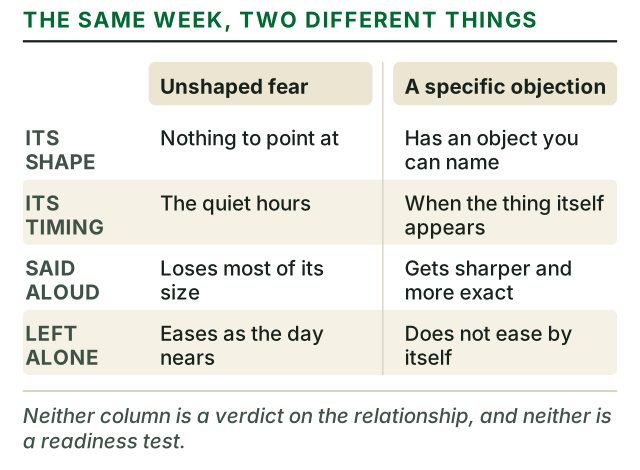
Cold feet is fear that attaches to the event rather than to the person, while a real objection attaches to the person and can be stated in a sentence.
A useful, unglamorous distinction: can you say what is wrong? For example, “I am terrified of standing in front of people and promising this again” is fear. “He will not talk about how money works between us, and changes the subject each time I raise it” is an objection with a subject and a verb.
Fear repeats itself. Objections accumulate detail. The first tends to loosen when it is spoken aloud to the person you are marrying. The second tends to sharpen, because it is describing something that is actually happening.
One more difference: cold feet often peaks and drops with the calendar. Objections do not care what date the venue is booked for.
Why does the fear arrive after you have already said yes?
Because agreement is what makes the loss real. While a relationship is undefined, the imagination can keep an exit open at no cost. A wedding closes that door, and everything the door was protecting shows up at once.
This is also why the fear can land hardest on people who are happiest. There is more at stake than there was in the dating months, and the mind measures fear against stakes, not against evidence.
Some of it is grief arriving out of order. A second wedding is one of the few occasions that puts the first marriage back in the room — its promises, its photographs, its language. Feeling something about that is not disloyalty to the person standing next to you.
What do the folk rules actually offer?
Very little as rules, and something as questions. The five-year rule and the 2-2-2 rule are folklore that circulates without evidence behind the numbers, and treating either as a threshold hands your decision to a stranger’s arithmetic.
What the five-year version gestures at is worth keeping: marrying in the middle of an unfinished ending tends to import the ending. That is not about a count of years. Consider somebody four years out with the divorce fully processed, and somebody eight years out still arguing in their head with an ex: they are in different situations, and no rule can tell them apart.
The same goes for readiness quizzes. This site does not publish them. A scored test converts a genuinely uncertain decision into a false result, and people remember the score long after they have forgotten how thin the questions were.
What if the fear is really about faith?
Then it is a different fear wearing the same coat, and it does not respond to reassurance about the relationship. Someone who believes their tradition may not recognise a second marriage is not frightened of commitment; they are frightened of being outside something.
That question belongs with the person who holds authority in your tradition, such as a priest, pastor, rabbi or imam, not with an article, and not with a partner who is trying to be kind about it. Where the conflict is grinding you down day to day, both routes matter at once: your clergy for the question, a therapist for what the question is doing to you. Our faith and guilt page sets out how the traditions differ without ruling between them.
What do people actually do the week the fear peaks?
Three things come up, none of them dramatic.
They say it out loud, to the right person. Naming a fear to a partner as a fear — “this is my history talking, not a doubt about you” — removes the guesswork that otherwise fills the silence. Stan Tatkin’s Wired for Love is written for couples about how partners handle each other’s alarm, which is the unromantic version of the same idea.
They stop hunting for certainty. No second marriage is entered with proof. Reassurance-seeking is the search for a guarantee that does not exist, and it keeps the fear circulating, because each fruitless hunt confirms the alarm rather than settling it.
They separate the fear of failing from the fear of being harmed. Those are not the same, and they need different responses. The first is a question about risk. The second is a question about safety, and it is not answered by an article.
If the fear is mostly the shape of what if it does not last, that is a specific worry with its own page: what the failure-rate fear is really asking. If it is mostly can I trust anyone with this again, that is a slower question about trust rather than about the wedding.
Where this page stops
This page describes an ordinary fear. It does not diagnose anyone, and it cannot tell the difference between dread and danger from where it sits.
Take it to a professional if the fear is constant rather than occasional; if it is physical — sleep gone, appetite gone, panic that arrives without a trigger; if it is running alongside low mood you cannot lift; or if it has stopped you functioning at work or with your children. Those are reasons to see a therapist or your doctor, not evidence about your relationship. A couples or stepfamily therapist is a reasonable first call, and the stepfamily counselling page explains what that work actually involves.
If the fear is not of failing but of being hurt — if any part of you is scared of this person rather than of the situation — please contact a domestic abuse helpline in your country. That is a different question from the one this page answers, and it deserves someone trained to hear it.
The rest of the doubts, the ones that are simply loud rather than dangerous, live in the feelings hub. Being frightened before a second marriage puts you in very ordinary company.