
Most people who look up stepfamily therapy are not looking for a therapist yet. They are checking whether things have got bad enough to need one, which is a quieter and harder question, and usually a sign that the household has been carrying something for a while.
Stepfamily therapy is family or couples work led by someone trained in how remarried households form, and it treats the household rather than one person as the client. This page describes what that work is, when people tend to start it, and how they find someone who actually does it. It does not assess your family. It cannot.
What is stepfamily therapy?
It is family or couples therapy with a therapist trained specifically in how remarried households form — where the strain sits in a stepfamily, and why the usual advice for first-marriage families often makes it worse.
The defining move is that the household is the client. Not the stepchild who slams doors, not the partner who goes quiet, not the ex. A therapist working this way is watching the structure: who has authority, who has history with whom, where loyalty runs, which decisions get made twice because there are two houses.
That reframe is the point. Families arrive certain that one person is the problem, and the arrangement is usually doing more of the work than the person is. The strains that arrangement produces are described on their own terms in the wider strain in blended families.
How is blended family marriage counseling different from ordinary couples therapy?
Ordinary couples work assumes the couple is the oldest relationship in the room. In a stepfamily it is the newest, and that single fact changes almost everything a therapist does.
A parent and child have years the marriage does not have. A therapist who ignores that will hand out advice — present a united front, back each other in front of the kids — that many stepfamilies try and find does not hold. Children often experience a new adult’s discipline as an intrusion before they experience it as care.
Blended family marriage counseling is couples work that starts from the marriage being the newest relationship in the house rather than the oldest. What happens in the early years of a marriage has its own research literature, including Carrere, Buehlman, Gottman and colleagues on predicting marital stability and divorce in newlywed couples. Stepfamily work starts from somewhere else again.
So stepfamily-trained work tends to go in a different order. They stabilise the couple’s private agreements first, keep discipline with the biological parent for a while, and let the stepparent relationship grow on its own slower schedule. It looks unambitious. It holds better.
There is also a third household in the material, whether or not anyone likes it. Good stepfamily work discusses the other home without turning it into a defendant, because the absent person is not there to answer and the children still love them.
When is stepfamily therapy worth starting?
When the same argument has returned unchanged for months, when the household has split into sides that no longer discuss things across the line, or when a child’s distress is showing up in places outside the home.
A stuck argument is one that comes back with the same script and ends in the same place, and it is the signal people describe most often as the reason they finally called someone. Sue Johnson’s Hold Me Tight, a general-reader account of emotionally focused couples work, describes what that kind of session looks like from the inside.
People wait too long, and they usually wait for a reason: starting feels like conceding that the marriage was a mistake. It is worth saying plainly that it is not. Second marriages carry a load first marriages do not, and getting help with a heavier load is not a verdict on the choice.
Some common moments couples describe as the point they finally called someone:
- The argument about the children now happens weekly and has a script.
- One partner has started keeping things back to avoid the argument at all.
- A child has said something that neither adult knows how to answer.
- One of the adults has begun to feel like a guest in their own house.
- The couple agrees privately, then does something different in the moment, every time.
None of that is a diagnosis of anybody. It is a description of pressure, and pressure is a reasonable thing to bring to a professional before it becomes something else.
Two honest halves
Family therapy for a blended family: what it feels like, and what the work actually is
The dread and the process are separate things. People who only ever imagine the first rarely get as far as the second.
What it feels like beforehand
Described by people who put it off
A fear of being told, in front of your partner, that you are the difficult one.
Worry that a stranger will side with the parent, because the children are not yours.
The sense that needing help so early means the marriage was a mistake — and that admitting it out loud makes it true.
Reluctance to describe the other household honestly in case it sounds like bitterness.
What the sessions tend to involve
Common structure, not a promise about your therapist
Early sessions with the couple alone, mapping who holds what authority and where the agreements break.
Children brought in selectively and briefly, if at all, and rarely asked to arbitrate between adults.
Concrete household mechanics: discipline, routines, how decisions travel between two homes.
Grief given room — for a first marriage, for the family a child expected, for the ordinary marriage this one was supposed to be.
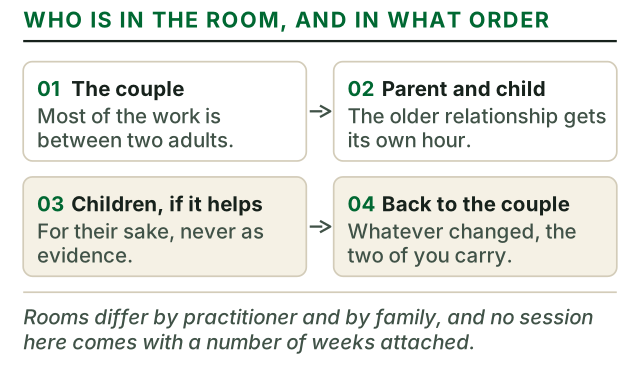
Who goes into the room?
Usually the couple first, sometimes for a good stretch before anyone else is invited, and children only when there is a specific reason.
Treating the household as the client means the therapist works on the structure — who holds authority, who has history with whom, where loyalty runs — rather than on one person’s behaviour. That surprises people who expected everyone on a sofa in week one. The logic is straightforward: most of the decisions that shape a stepfamily are made by the adults, and children are poorly served by being seated at a negotiation they cannot influence. A child who has already watched one household reorganise around adult conflict does not need a front-row seat at the second.
Where children do come in, therapists tend to see them briefly, separately, or alongside their own parent rather than the whole assembled group. A stepparent’s absence from those sessions is not a demotion. It is often what makes the child able to speak.
What happens in the first sessions?
Mostly mapping. Who lives where and when, who was here before whom, which subjects cause the temperature to change, and what each adult believed the household would feel like by now.
A therapist will usually ask each person to describe the same week and will listen for where the accounts diverge. The divergence is the material. Couples frequently discover, for example, that they are not arguing about bedtime at all — they are arguing about whether the marriage is allowed to have needs that compete with a child’s.
The work after that is unglamorous and specific: agreements about discipline, about information, about what happens when the other household changes plans. If you are already stuck on that last one, the ground-level version is set out in boundaries as agreements between the couple, and the split it usually causes has its own page in when partners disagree about the children.
How do you find a stepfamily therapist?
By filtering for training rather than for tone, and then asking direct questions in the first call before you commit to a course of sessions.
Start with your country’s professional register or national therapy directory rather than a general search, so that whoever you find is accountable to a body. Then look for the words that indicate the specialism, such as stepfamily, blended family, remarriage, or sometimes “family systems”. A warm profile with no stepfamily experience is a slower route than a plain one with it.
Questions worth asking on the phone:
- How much of your work is with stepfamilies? You want a real answer, not a reassurance.
- Would you start with the couple, or with everyone? Either can be right; you are listening for a reasoned approach rather than a default.
- How do you handle the other household when it comes up? Look for someone who neither dismisses it nor recruits you against it.
- What does progress look like in this kind of work? Vague answers here tend to stay vague later.
- Do you work with faith backgrounds like ours? Relevant if the remarriage itself is contested in your tradition; some people want their minister and their therapist to be different people, and that is a workable arrangement.
Cost and availability vary by country and by service, and this page cannot tell you what yours will be — ask at the first contact, and ask whether the practice has a lower-cost route.
What this page does not recommend
We do not recommend going to therapy in order to have a professional confirm that you are right. Therapists notice it quickly, the sessions stall, and the person hoping for a verdict usually leaves angrier than they arrived.
We do not recommend sending a stepchild to individual therapy as a way of managing an adult conflict, and we do not recommend using a session to relay complaints about the other parent through a child. We do not recommend “readiness quizzes” or online tests that grade your family — nothing that scores a household from a form knows anything about it.
We also do not recommend expecting a fast result. The honest version is that stepfamily work is often slow, that it can feel worse before it settles, and that the change usually shows up first in how a bad evening ends rather than in whether bad evenings happen.
Where this page stops
This page is a description of a kind of help. It is not an assessment of your family, and it makes no judgement about anyone in it — not your partner, not the children, and not the parent in the other house.
If the strain is beyond what agreements can hold, the next step is a qualified family or couples therapist in your country rather than another article. If anyone in the household is being hurt, threatened, or is frightened of another person, contact a helpline in your country now; that situation needs a professional response, not counselling homework.
The wider emotional load of a second marriage — the doubt, the comparisons, the ordinary tiredness of a family that had to be built rather than inherited — sits in when it strains. Most of it is common, even when it feels like it belongs only to your house.