
Second marriage conflict over children is one of the fault lines couples describe most often, and the argument almost never happens where it looks like it is happening. It arrives dressed as a specific incident, such as a bedtime ignored, a rude answer let pass or a weekend rearranged again, and then repeats with different details for years.
Couples who describe it often say the same odd thing: the fight feels enormous and the subject feels trivial. Both are true. The subject is trivial. The thing underneath it is not.
Why does a second marriage conflict over children start?
Because two adults married each other without ever agreeing what the stepparent is allowed to be. The children then supply the situations that force the question, one at a time, in real time, usually with everyone tired.
In a first marriage, parenting roles are built slowly and jointly, over years, before there is anyone to parent. In a second marriage, an adult walks into a family that already has a history, its own rules, its own grief and a parent who has been managing alone. Nothing about that arrangement announces where the new person stands.
So it gets decided by incident. Someone corrects a child, someone else stiffens, and a position that was never discussed is suddenly being defended.
Why does it feel like your spouse takes his kids’ side?
He may well be doing exactly that. Partners who describe this pattern often trace it to guilt rather than to a ranking of who matters more.
Taking the children’s side is, in most of these accounts, guilt rather than preference: a parent defending before he has formed an opinion. The practised speed of that kind of reaction is the territory of Harriet Lerner’s The Dance of Anger, a general-reader book on patterns of anger in close relationships.
A parent who has watched his children live through a separation tends to carry a running account of what it cost them. Inside that account, a complaint about a child’s behaviour does not sound like a complaint about behaviour. It sounds like another bill arriving for a decision he made. The defensiveness is fast, and it is often faster than his own opinion.
The new partner hears something different: that she can be overruled by anyone in the house who is still a child. That she is a guest with chores. That the marriage has a ceiling.
Neither reading is invented. They are two accurate accounts of the same moment, which is exactly why the argument does not resolve by establishing what happened.
Two accurate accounts
Parenting conflict in a second marriage: what each of them is actually saying
Most of these arguments are two people describing different problems in the same sentence. Naming which one is on the table changes the conversation more than winning it does.
What the stepparent feels
Described by people in the role
That the rules of the house depend on which child is in it, and nobody will say so out loud.
Being asked to contribute money, time and patience while having no say worth the name.
Suspecting that raising anything about the children marks you as the problem — that the safest version of you is silent.
A quiet fear that if it ever came to a straight choice, you already know the answer.
What the parent feels
Described by parents in second marriages
That his children have already lost one household and he is not willing to hand them another loss.
Being caught between two people he loves, with no version of the evening where somebody is not hurt.
Hearing criticism of a child as criticism of his parenting, and of the years he spent doing it alone.
Guilt that makes leniency feel like repair, even when he can see it is not working.
What is actually being argued about?
Three questions, usually, and none of them is the incident. Who has authority over the children. Whose comfort gives way when they conflict. And whether the marriage or the parent-child bond is the load-bearing wall of the household.
The load-bearing question is the last of those: which relationship holds the household up, the marriage or the parent-child bond. It is the hardest to see, because couples often believe it has an obvious answer and believe different obvious answers. One partner grew up with the marriage at the centre. The other has spent years with a child at the centre out of necessity, and the shape stuck.
Nobody is lying. They simply never compared blueprints, and now they are building on the same plot.
Who is supposed to handle discipline?
This page is not going to tell anyone how to raise another person’s children, and it is worth being suspicious of pages that do — they have no idea who is in your house.
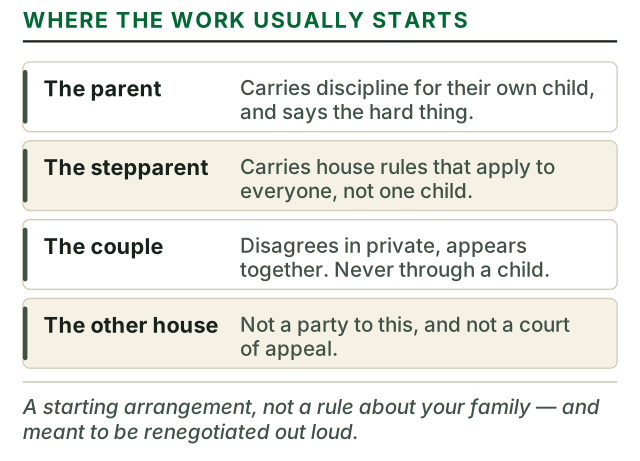
What can be said is what couples tend to arrive at on their own after a few bad years. Early on, the child’s own parent generally carries correction and consequences. The stepparent’s role is closer to a responsible adult the child lives with than to a second parent, and it widens as the relationship earns it rather than as the marriage certificate awards it.
The part couples underestimate is that this arrangement only works if the parent actually does the job. Delegating authority is not the problem. Handing over responsibility while withholding authority is, and it is a reliable route to a resentful stepparent.
Why do the same arguments come back unchanged?
Because each round is spent adjudicating the incident, and the incident was never the disagreement. Solve the bedtime and you have solved bedtime.
A repeating argument is one where every round adjudicates a fresh incident and leaves the disagreement underneath it untouched. What couples do in those rounds, rather than what they conclude about each other afterwards, is the subject of John Gottman and Robert Levenson’s paper on marital processes predictive of later dissolution.
There is a recognisable loop. Something happens. The stepparent raises it. The parent defends. The stepparent escalates to be taken seriously. The parent now has evidence that the criticism was disproportionate. Both retreat with their original position reinforced, and the next incident is already scheduled.
Couples who break the loop generally stop arguing about events and start deciding policy at a neutral hour — not during, not after, but on a Tuesday when nothing has happened. The wider strain in blended families tends to concentrate exactly here, in decisions that never get made when nobody is upset.
What about the children in it?
Assume they notice. Children read tension more accurately than they read motives, and a house where two grown-ups are quietly at odds registers with them long before anything is said.
Two things get carried by children that adults intend to keep between themselves: which adult is really in charge, and whether the stepparent is permanent. Both get tested — sometimes deliberately, more often not — and the testing is frequently mistaken for hostility. A stepchild who repeats the same question about next weekend, for example, may be checking the arrangement rather than complaining about it. A stepchild who is cold, or who says the loyal thing about an absent parent, is often not rejecting anyone. They are checking whether this arrangement is safe to rely on.
That is slow to answer and it cannot be argued into place.
When does a therapist or mediator help more than another conversation?
When the same disagreement has survived several honest attempts to settle it, when one partner has stopped raising things, or when the children have started organising themselves around the tension.
The two routes are not interchangeable. A mediator typically works on arrangements between households — schedules, handovers, decisions co-parents share — and the new spouse is often not at that table. A couples or stepfamily therapist works on what is happening inside this marriage: roles, guilt, authority, the sense of being outranked. Some families need both, and they are separate rooms.
Going is not an admission that the marriage is failing. Stepfamily work is one of the areas where couples describe outside structure doing obvious heavy lifting, mostly because it forces the policy conversation that never happens at home. What stepfamily counselling actually involves covers how that work is set up and how people find someone who does it.
What this page does not recommend
We do not recommend issuing ultimatums about someone’s children, or asking a partner to choose in a form where the only dignified answer is his child. That conversation cannot be won, and losing it is not survivable in the way people imagine.
We do not recommend running discipline through the stepparent to spare the parent the conflict. We do not recommend correcting the other household’s rules through the children, keeping score of what each child costs, or treating a child’s coolness as evidence to be presented later. And we do not recommend deciding what a child “really” is — they are a child, or a teenager, and they did not design this.
Most of this advice circulates because it feels like action. It tends to produce a household where a child is the terrain and two adults are the armies.
Where this page stops
This page describes a pattern. It cannot see your family, it does not know your stepchildren, and it does not diagnose anybody in your house.
If the disagreement has become permanent, if one of you has gone quiet to keep the peace, or if you are asking yourself whether to stay, that is the point to bring in a couples or stepfamily therapist rather than another late-night attempt. Related pressure sits in the strain hub, and where the conflict is tangled up with the other household, boundaries as agreements between the couple covers the part the two of you actually control.
If a child is being harmed, frightened, or used against an adult in either household, that is not a parenting disagreement and it is outside what any article can hold. Contact a child protection service or a family helpline in your country, and speak to a professional who can see what is in front of them.