

Most searches for new wife and ex wife boundaries are looking for a sentence — the right phrasing that will finally make the calls stop, the drop-offs stay on time, the comments end. That sentence does not exist, and the search for it is usually a sign that the boundary is being aimed at the wrong person.
New wife and ex wife boundaries are agreements a couple makes with each other about contact, time and information inside their own home, rather than rules handed to the ex. A boundary you need someone else to keep is not a boundary. It is a request, and requests can be declined.
What are healthy boundaries between a new wife and an ex wife?
Healthy boundaries between a new wife and an ex wife are agreements between the couple about how their own household runs, held consistently over time, and they do not require the ex to cooperate for them to work.
That distinction sounds like wordplay until you watch it operate. “She must stop texting after ten” depends entirely on her. “Messages after ten are read in the morning” depends on nobody but you two. The first will be tested. The second cannot be broken, only disliked.
Boundaries that survive a second marriage tend to have that shape. They describe what this house does, not what the other person must stop doing.
Who is the boundary actually with?
With your partner, in the ordinary case. This is the part that stings, and it is also the part that returns some control to people who feel they have none.
The new wife rarely has a relationship with the ex, and often has no standing to set terms with her at all. What she has is a marriage, and inside that marriage a set of unanswered questions: what gets shared, what gets defended, what happens when a message arrives at dinner.
When those questions are unanswered, the ex becomes the visible problem. When they are answered, she becomes weather — sometimes bad weather, but not the thing being argued about at eleven at night.
Two honest halves
Boundaries with an ex spouse: what it feels like, and what couples actually agree
The feeling and the agreement are separate work. Couples who do only the first stay in the same argument.
What it feels like
Described by people living in it
A sense that your home has a third adult in it who did not agree to any of the rules.
Watching your partner's face change when a name comes up on the screen, and reading everything into it.
Feeling petty for minding things that sound small out loud — a nickname, a photo, a habit of calling rather than texting.
Being cast as the one who is 'making it an issue' simply because you are the one who says it aloud.
What couples agree
Common arrangements, not prescriptions
One channel for non-urgent contact, and an agreed definition of urgent that includes the children being unwell.
Which topics the partner answers alone, and which ones he brings to the marriage before replying.
What the new wife is not asked to carry: relaying messages, arranging handovers, or interpreting tone.
A standing rule that neither of them discusses the other household within the children's hearing.
What do couples usually put a boundary around?
Four things, in the order they tend to cause trouble: communication, time, information, and the children’s ears.
Communication. Not whether contact happens — with shared children it must — but where it lands. A single channel with a predictable response window removes much of the ambiguity that makes a phone feel like a threat. For example, a couple may agree that non-urgent messages go to one app and get answered in the evening rather than at the dinner table.
Time. Which evenings, holidays and rooms belong to the marriage, and what actually justifies interrupting them. Couples who never decide this end up renegotiating it in real time, every time, usually in front of everyone.
Information. How much of the former marriage the new wife hears, and how much of the new marriage travels back, such as a job change or a health worry that has not been mentioned at home yet. Both directions matter, and couples usually only notice the second one after it has caused an incident.
The children’s ears. The boundary this site would put above the others: adults’ disagreements are not carried by children, in either direction. This one is worth holding even when the other household does not.
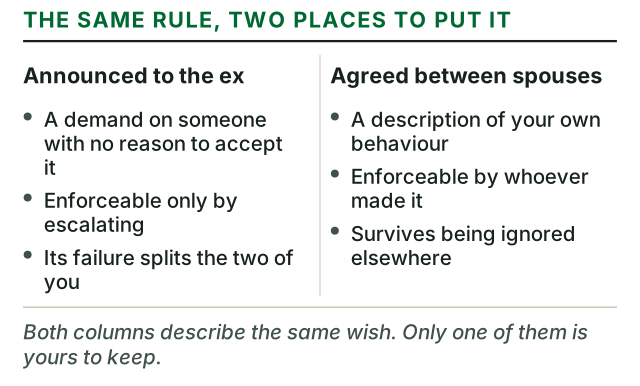
Why do boundaries fail when they are announced to the ex?
Because an announcement converts a household decision into a contest, and it hands the ex a role she may be very willing to take.
An announced boundary is one delivered to the ex as a correction rather than simply lived out at home, and the delivery is what turns a household decision into a negotiation.
There is a common sequence. The couple decides something. Someone tells the ex, usually in the tone of a correction. She responds — sometimes badly, sometimes reasonably — and now the decision is up for debate, with the couple defending it rather than living it. Before long everyone is arguing about the boundary instead of using it. How couples handle recurring disagreement has been examined on its own terms: John Gottman and Robert Levenson’s paper on marital processes predictive of later dissolution looks at the way couples’ conflict interactions relate to whether a marriage lasts.
Quiet boundaries are more durable and much less satisfying. There is no moment where anyone concedes. There is only a slow change in what is predictable, which is what a household actually runs on.
How are co-parenting boundaries different?
They are limited by something the couple does not control: the children’s need for both parents, and often a court-ordered arrangement that the marriage does not get to rewrite.
Co-parenting boundaries are the agreements that sit around a parenting relationship the marriage cannot end, which is why they are narrower than the ones a household sets for itself.
The emotional consequence of that is worth saying plainly. Co-parenting boundaries with a new spouse in the house are narrower than people want them to be. The contact does not end. The other parent stays in the calendar. A new wife who was hoping the marriage would eventually shrink that relationship is usually in for a long disappointment.
What can change is her position in it. Couples often land somewhere like this: the parents handle the parenting, the stepparent is not the messenger, and the new wife’s opinions go to her husband rather than into the co-parenting thread. That arrangement is not a demotion. It removes a job nobody ever agreed to give her. The same distinction between a limit you keep yourself and a demand you make of someone else runs through Nedra Glover Tawwab’s Set Boundaries, Find Peace, a general-audience book about boundaries.
The formal side of it — orders, schedules, who has what right — is a legal matter, and this site does not handle those. What we handle is the part where the two of you are on different sides of the same question, which is where partners disagree.
What if the boundary is really a request to be chosen?
Sometimes it is, and noticing that changes what needs to happen next.
Underneath a lot of boundary arguments is a much shorter question: if she pushes, will you stand with me? That question does not get answered by a rule about text messages, which is why the rules keep multiplying and nothing settles. Each new rule is another attempt to get an answer that only a person can give. For instance, a rule about response times can be agreed, kept to the letter, and still leave the real question untouched.
If that is what is happening, the conversation to have is the direct one, and it is with your husband. Being second in time is not the same as being second in priority, though the two get confused constantly. That confusion has its own page: what living next to his ex-wife actually feels like.
What this page does not recommend
Some of the most commonly shared advice in this area is designed to win a conflict rather than end one, and it tends to cost more than it returns.
We do not recommend collecting evidence against an ex for future use, monitoring your partner’s phone, screenshotting messages to build a case, or arranging situations to demonstrate to anyone who matters more. We do not recommend “putting her in her place,” and we do not recommend deciding what she is from a distance — she is a person outside your knowledge, not a character in your marriage.
We also do not recommend using children as a source of information about the other household. It is the most tempting one and the most damaging, and it is the one we would give up last.
None of that is a moral scolding. It is the observation that couples who go down those roads spend their marriage on the ex, and the ones who agree between themselves spend it on each other.
Where this page stops
This page describes agreements between two people. It cannot see your situation, and it does not diagnose anyone — not your partner, and certainly not his former wife.
If the pattern is grinding on, if the same argument returns unchanged, or if the children are visibly caught in it, that is a reasonable point to bring in a stepfamily or couples therapist rather than another rule. What stepfamily counselling actually involves sets out how that work is structured and how people find someone.
If any contact involves threats, stalking, intimidation, or you find yourself frightened of a person rather than exasperated by one, that is outside what boundaries can address. Contact a domestic abuse helpline in your country, and speak to a solicitor or family lawyer about the parts that are legal rather than emotional. That is a different question from the one this page answers, and it deserves someone trained to hear it.
The rest of it — the patterns, the jealousy, the long adjustment of living alongside someone’s history — sits in the ex factor hub. It is more familiar than it feels from inside, even when it feels like it belongs only to you.