

Searching how to protect yourself from your husband’s ex wife usually means one thing: something is reaching into your home and you cannot stop it at the door. A message at eleven at night. A plan changed on Friday. A version of your husband that only appears after he has spoken to her.
How to protect yourself from your husband’s ex wife is, in the end, a question about your own household rather than a question about her. The search assumes protection is something you build against a person. Almost none of it is. She is outside your reach, and the strategies that promise otherwise tend to cost you the marriage they claim to defend.
How do you protect yourself from your husband’s ex wife?
By changing what happens inside your marriage rather than what happens in hers. You cannot control her behaviour, her tone, or her opinion of you. You and your husband can decide what reaches your household, who answers it, and what you refuse to relitigate.
That reframing is not a consolation prize. What wears a second wife down is often not the ex-wife’s conduct in the abstract; it is being alone with it. Being handed a decision after it was made. Watching a phone screen go face-down. Learning that a weekend changed from a child rather than a spouse.
Those are all things that happen inside the house. Which means they are the things that can actually change.
What does “protecting the marriage” mean in practice?
It means the two of you have agreements about the ex-relationship that you made together, on a calm day, and that neither of you improvises alone under pressure.
Couples who settle into this tend to have decided a handful of dull things in advance. Which channel co-parenting contact uses. Who replies, and how quickly — including the fact that not every message needs an answer that hour. What subjects are in scope, which is usually the children and very little else. What the two of you do when a message arrives that is designed to provoke. For example, a couple may agree that anything arriving during dinner is read once the children are in bed.
None of that is a weapon. It is closer to household infrastructure: the boring plumbing that keeps one difficult relationship from flooding every room. Our page on boundaries with exes goes through how couples build those agreements without turning them into ultimatums.
Two honest halves
An ex wife interfering in marriage: what it feels like, and what couples do with it
The feeling and the response are different things, and mixing them is what makes these weeks so exhausting. Neither column is a verdict on anyone's character.
What it feels like
Described by people living inside it
A sense of being the guest in a household that has an older set of rules than yours.
Vigilance about the phone — who is texting, what changed, what you will find out last.
Anger that has nowhere to go, because the person it is aimed at is not in the room.
Guilt about the anger, especially where children are involved and nobody is behaving badly on purpose.
The suspicion that raising it will make you the difficult one in your own marriage.
What couples do with it
Common responses, not prescriptions
Move the complaint from her to the arrangement: not 'she did this', but 'we need to decide how we handle this'.
Agree a single contact channel and a normal response window, so surprises stop arriving through side doors.
Decide together what the household does not renegotiate — the same answer given twice is usually the end of it.
Keep children out of the message chain in both directions, including as sources of news.
Take the recurring version of the fight to a stepfamily therapist rather than to another year of the same evening.
Why does advice to “handle her” usually make things worse?
Because it puts you in a contest you did not choose, on ground you do not hold, in front of children who will remember it.
A great deal of what circulates online is quietly adversarial: scripts to put her in her place, advice to screenshot everything, encouragement to build a case. Some of it is dressed up as self-protection. Its actual effect is to move your attention outward, onto a person whose behaviour you cannot change, and away from the one relationship where your influence is real.
Adversarial advice is any suggestion whose success depends on the other household reacting a particular way, such as a script, a staged confrontation or a file of collected evidence. Anger in close relationships has a literature written for general readers: Harriet Lerner’s The Dance of Anger is about the patterns anger settles into between people.
There is also a reputational cost that lands unevenly. Second wives often describe being the one whose reactions get read as evidence. That is unfair, and it is worth knowing before you draft the message you have been composing in your head since Tuesday.
This site does not publish tactics for managing another adult. Not out of delicacy — because they do not work, and they hand your evenings to someone who is not in your marriage.
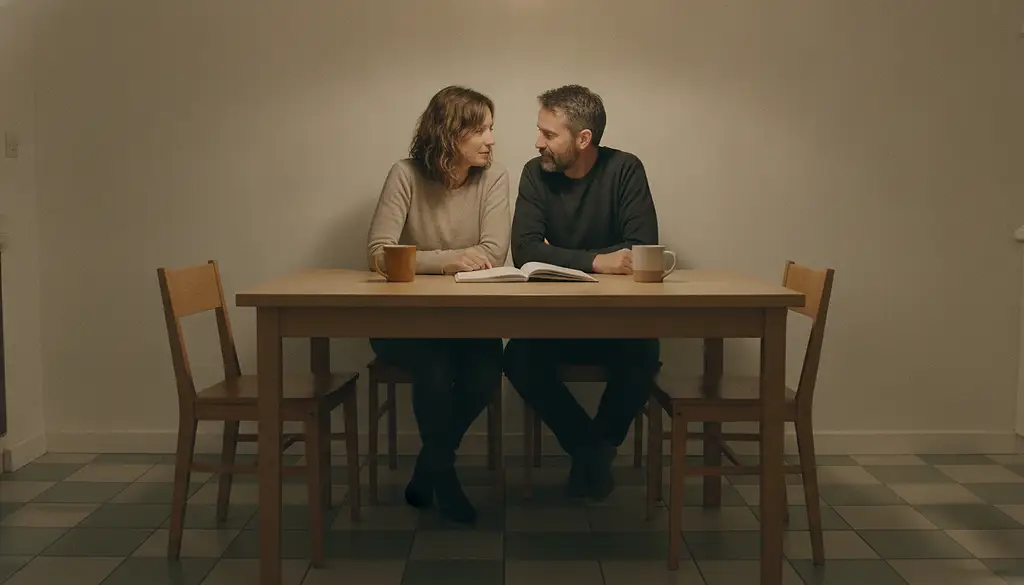
What if your husband will not hold the agreements?
Then the difficulty is inside the marriage, and it is the one worth naming. This is the point most articles avoid, and it is usually the real question underneath the search.
If your husband agrees to something on Sunday and folds on Wednesday, the fight you are having is not with his ex-wife. It is about whether the two of you can decide anything and have it survive contact with pressure. That is a marital conversation, and it is uncomfortable, and it does not improve by being aimed at her instead.
An agreement that folds is one made to end a conversation rather than to be lived with, and it tends to return as the same argument later. Differences in the way adults handle closeness and conflict are described in Kim Bartholomew and Leonard Horowitz’s paper setting out a four-category model of adult attachment.
Some of it is not weakness. Fathers who are frightened of losing time with their children will absorb a great deal to keep the peace, and that fear is worth understanding before it is argued with. Some of it is guilt about the divorce, still unfinished. Some of it is simple avoidance.
What matters is that it gets discussed as a shared problem rather than a loyalty test. “Whose side are you on” ends the conversation. “I cannot keep finding out afterwards” starts one.
Where do the children fit in this?
Outside the conflict, as far as the two of you can manage it, even when the arrangement is unfair to you personally.
Children carry messages if adults let them, and they learn very quickly which house rewards which news. Keeping children out of it means not asking what happened at their mother’s, not correcting her account in front of them, and not treating their affection as a scoreboard. It is the least satisfying discipline in a stepfamily and one that people say afterwards they were glad they kept.
It also protects you. A stepmother who never made the children choose has a floor to stand on, whatever else is said about her. The emotional weight of that — the resentment, the sense of doing all the giving — is a real load, and it is what our page on living alongside his ex-wife is for.
When is this beyond what a couple can sort out alone?
When the same argument keeps returning without moving, when a child is visibly caught in it, or when one of you has stopped bringing things up because the cost is too high.
Stepfamily therapy is unglamorous and specific: a third person in the room whose job is the arrangement, not a verdict on anyone. Couples often arrive at it late, after the pattern has hardened, and say afterwards that the useful part was simply having the conversation somewhere neither of them could leave the room. For instance, the same disagreement about weekends gets aired once, in full, instead of in fragments at the door on the way out. What that work involves, and how to look for someone who does it, is set out on our stepfamily counselling page.
Mediation exists for the arrangements themselves, and lawyers exist for the legal shape of custody and money. Those are real routes; they are simply not what this site covers.
Where this page stops
This page describes ordinary friction between households. It does not assess anyone, and it cannot tell from here whether what is happening to you is difficult or dangerous.
If contact has become harassment — threats, repeated unwanted approaches, anything involving your safety or your children’s — that is not a boundary problem and it should not be handled with better agreements. Take it to the police, to a solicitor, or to a domestic abuse helpline in your country, whichever fits what is happening.
If the strain has moved inside you — sleep gone, dread that does not lift, a mood you cannot shift — that belongs with a therapist or your doctor, not with an article about someone else’s behaviour.
The rest of it, the long ordinary grind of sharing a family with a person you did not choose, lives in the ex factor hub. Nobody handles it gracefully at first, and the couples who settle are not the ones who won.