
Christian views on remarriage after divorce are not one teaching with a few dissenters. They are a small set of settled positions, each built on a reading of the same short group of texts, and the differences between them are centuries old rather than modern drift. Knowing which position your own tradition holds — and what it holds it from — is usually more useful than knowing what most churches say.
This page is the frame for the section, not the answer. It sets out what the disagreement is made of, which pages here cover which part of it, and where this site stops. Nothing below rules on your case, and nothing below is a substitute for the person in your own tradition who would actually answer it.
What is the disagreement actually about?
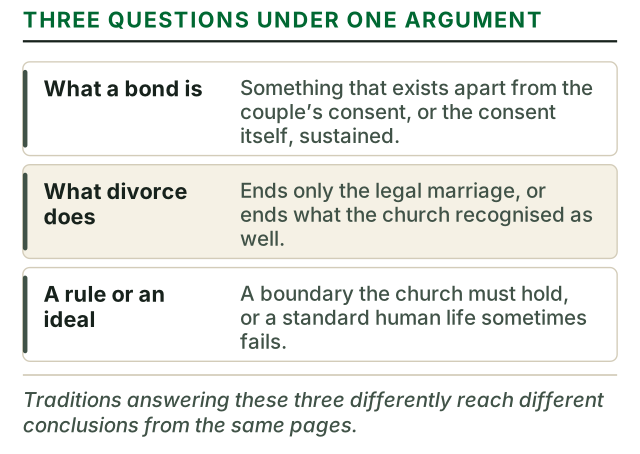
It is about what a marriage is, not about what the verses say. Every tradition here reads the same Gospel sayings on divorce and the same handful of letters; almost none of them disputes the wording. The split is over what those words close and what they leave open.
A marriage bond is, in the stricter traditions, something made once and not undone by a later civil decree — which is why the Catholic route runs through the annulment question rather than through divorce. Wider readings treat the same sayings as naming an ideal that human lives sometimes fail, and treat the church as having room to meet that failure. Consider how differently those two starting points make the same sentence land: on one, a second marriage is a question about whether the first bond existed; on the other, it is a question about mercy applied to a broken situation.
The pages that unpack this are what the Bible says for the texts, positions by denomination for where the traditions stand, and is remarriage adultery for the sharpest version of the question.
Why do two careful readers reach opposite conclusions?
Because the passages contain an exception clause, a pastoral letter and a silence, and each tradition weighs those three differently. Nobody in this argument is being careless.
An exception clause refers to the phrase in Matthew that names a ground on which divorce is discussed differently. Traditions that treat it as narrow and traditions that treat it as illustrative end up in different places without either side inventing a word. Add to that a letter of Paul addressing a situation the Gospels do not, and the space for honest divergence is real rather than rhetorical.
This is why the pages here put readings next to each other at equal weight instead of ranking them. A page that lets one column win has stopped describing the disagreement and started taking a side in it.
What do couples do when they read it differently?
They usually stop trying to win the reading and start naming which parts of the question belong to each of them. That is a relationship conversation rather than a doctrinal one, and it goes better when it is treated as one.
A mixed-conviction couple is one in which the partners hold different positions on whether this marriage is permitted in their own tradition, and the difference does not resolve by one of them being argued into the other’s church. The general research on how couples handle persistent disagreement — the line of work in Gottman and Levenson’s study of marital processes — is about the manner of the disagreement rather than its subject, and it is the manner that tends to be inside a couple’s control. Imagine the same evening run twice, once as a debate with a verdict at the end and once as two people describing what they are each carrying; the doctrine is identical in both, and the marriages are not.
Where the conflict is specifically about guilt rather than about doctrine, forgiveness and guilt is the page for that, and it is a different room from this one.
What if a pastor or priest says no?
Then the answer you have received is about your case in that tradition, and it is not a statement about your worth. It is also not always final in the way it first sounds, because different traditions have different routes — an annulment process in one, a penitential path in another, a different congregation in a third.
An annulment is a finding about whether a marriage was validly made in the first place, not a church divorce, and the distinction is the whole reason the Catholic pages here are separate from the rest. That is covered in Catholic annulment and remarriage, and the practical and emotional side of a refusal is covered in when a pastor will not marry us.
Where this section stops
These pages describe. They do not permit, forbid, or advise, and they do not tell you which tradition is right. Where a reading is contested, both readings appear at equal weight, and neither one is this site’s position.
If you are trying to decide, the conversation that matters is with your own pastor, priest or confessor, and these pages are only worth reading as preparation for it. If what you are actually carrying is guilt or fear rather than a question of teaching, the doubts section is written for that, and a therapist is a better first call than a website.