

Remarriage in the Catholic Church is governed by a question asked about the first marriage rather than about the second: not whether it failed, but whether it was validly made. This page describes what that claim is, what a declaration of nullity does and does not say, and who is entitled to decide.
What does the Catholic Church actually teach about remarriage?
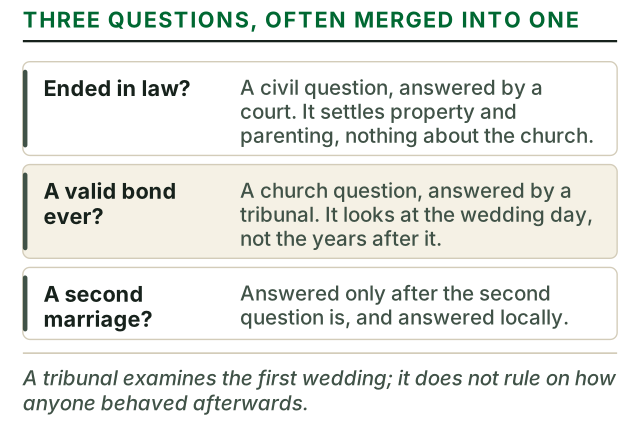
Remarriage in the Catholic Church starts from one teaching: that a marriage validly made between two baptised people lasts until one of them dies, and that no court and no church office can end it. A civil divorce, on this teaching, settles property, custody and legal status — it does not touch the bond. A court can, for example, divide a house, split a pension and end a legal partnership, and none of that reaches the bond as the Church describes it.
Everything else follows from that single claim. If the bond stands, a second wedding while the first spouse lives cannot be a marriage in the Church’s eyes. So the Church does not ask whether the first marriage ended. It asks whether it ever began.
That is the question a declaration of nullity examines, and it is the reason Catholic conversations about remarrying sound so strange from outside. Other traditions debate whether a broken marriage can be released. This one debates whether it was made.
Is an annulment a “Catholic divorce”?
No — and the difference is not a technicality, it is the whole thing. A divorce works forward in time: a marriage existed and now it does not. A declaration of nullity works backwards to a single day, the day of consent, and asks what was actually present in the two people who spoke the words.
Canon law asks a single question about the beginning: what was actually present in the two people at the moment they consented. A declaration of nullity is that inquiry written down — a tribunal’s judgement that something essential to consent was absent, so what looked like a marriage was not one in the full sense. Which absences count, and how they are weighed, is a question for your parish rather than for a page.
Which is why the phrase “Catholic divorce” annoys almost everyone. Catholics hear it as a caricature of a serious inquiry. Critics hear the official language as a polite way of getting the same result. Both reactions are common enough that it is worth showing them next to each other rather than pretending one does not exist.
Read side by side
Two honest readings of the annulment process
This is a live argument, held by serious people inside and outside the Catholic Church. Both readings are stated here as their holders would state them.
Read as an honest question
How tribunals, canon lawyers and many Catholics describe it
The inquiry is about consent, not about who behaved worse. It exists because the Church takes the bond so seriously that it will not simply release it — the only honest route is to examine whether it was formed. Petitioners often describe the process as the first time anyone asked, carefully and without taking sides, what actually happened at the beginning.
Read as a legal workaround
A criticism voiced by some Catholics, by some Orthodox writers, and by many people outside the churches
On this reading the language is doing the work the doctrine forbids: a marriage that plainly existed, with years and children in it, is retroactively described as never having been one. Critics say the categories of psychological incapacity are wide enough to fit almost any unhappy story, and that mercy would be more honest if it were called mercy.
Which texts is the Catholic position standing on?
The same short set that every Christian tradition argues over: the Gospel sayings on divorce in Matthew, chapter nineteen, and Mark, chapter ten, the exception clause that Matthew has and Mark does not, and Paul’s instruction to the Corinthians in First Corinthians, chapter seven, from which the Church draws what it calls the Pauline privilege.
The Pauline privilege is the name the Church gives to what it draws from that passage: a provision concerning a marriage between two unbaptised people where one is later baptised and the other departs.
The traditions do not disagree about what the words are. They disagree about what those words close and what they leave open — whether Matthew’s exception names a case where remarriage is permitted, and whether Paul’s allowance is a narrow provision or a wider principle of pastoral freedom.
The Catholic reading takes the sayings as stating that the bond itself is indissoluble, which pushes the whole question upstream into validity. We describe those readings at more length, with who holds what, in what the Bible says about divorce and remarriage. We do not adjudicate between them here or there.
Can a Catholic remarry without an annulment?
Civilly, yes; the state marries whoever it recognises as free to marry, and many Catholics do exactly that. Canonically, no: with the first bond still held to stand, the Church does not recognise the second union as a marriage, and that has consequences inside parish life. A civil marriage is a marriage made and recorded by the state, and in this situation the Church does not read that ceremony as a sacramental one.
What those consequences are in practice varies more than people expect, and the pastoral question of who may receive the sacraments in that situation has been argued about intensely in recent years, including in Amoris Laetitia and in the responses to it. We are not going to settle that here or tell you what your parish will say. It is one of the few questions where the answer genuinely depends on the priest in front of you, and asking him directly is faster than any reading you can do alone.
What is worth naming is the position it puts people in: attending, belonging, raising children in a church that does not regard your marriage as one. Some describe that as exile. Others describe it as a long wait they chose with their eyes open. Both are honest reports of the same arrangement.
What does this do to the family while it is open?
It leaves a question mark over the household, and children read question marks accurately even when nobody explains them. A fear often brought into a parish office is about their status — and on that point the Church states that a declaration of nullity does not change the status of children of that union, and that their parents’ duties to them do not change. What civil law says varies from country to country, so that half of the question belongs with your own diocese and a lawyer rather than with us.
The second strain is time. A petition takes as long as it takes, and a couple waiting on it often puts other decisions on hold — a date, a move, or whether to say anything yet to extended family, for example — which turns an administrative delay into an emotional holding pattern. Naming it as a wait, rather than as a verdict pending on your worth, is most of what makes it survivable.
The third is the former spouse. Whether and how a former spouse is contacted is one of the things to ask your parish about early, because the answer can reopen what a household thought was settled. If it does, the strain lands on the new couple rather than on the tribunal, and it is worth deciding together in advance how much of it you want to discuss at home.
What should you ask your parish?
Questions, not a case. The conversation starts with a person rather than a form — your own priest or deacon — and the most useful thing to bring is a short list of what you do not know. Consider writing that list down beforehand, because the meeting tends to move faster than people expect.
Worth asking:
- Is a petition something my situation would go through at all, and who decides that?
- Who at the diocese would help me with it, and how would I reach them?
- Whether and how a former spouse is contacted.
- What happens if the answer is no, and whether anything can be looked at again.
- Which document a headline I have read was actually summarising.
We deliberately do not publish a walk-through of how to present a case. Pages that coach people on what to say to a tribunal are teaching them to perform an answer, and that corrupts an inquiry whose entire subject is honesty about what was in someone’s mind years ago. It also encourages the assumption that a petition is a form to be beaten.
What we will say is that the process is slower and more personal than the internet suggests, and that outcomes are not promised in advance. Where the Church has written about the procedure, the texts are published — ask your parish which one applies and read it in the original rather than in summary.
What if you are not sure you want to open this at all?
That is a real position and it is more common than the polished testimonies suggest. Opening a petition means retelling the beginning of a marriage to strangers, in detail, often while the person you are now marrying waits. Some people find that clarifying. Some find it unbearable and stop.
There is also the couple who cannot agree: one wants the marriage recognised by the Church, the other cannot see why a tribunal in another city gets a say in their life. That disagreement is rarely solved by argument, because it is not really about canon law — it is about what each of them thinks a promise is.
If the pressure has moved from the question into your body — sleep, appetite, the sense that you are two people at once — that is the point where a confessor and a therapist do different jobs and you may need both. The guilt that hangs around this, whatever a tribunal decides, has its own page: feeling guilty about a second marriage.
What this page will not do
Some of this is caution. Most of it is the shape of the subject.
- Tell you your odds
- Grant and denial figures circulate constantly, usually stripped of the country, the year and the definition behind them. We do not repeat numbers we cannot source, and neither should the forums.
- Coach your testimony
- No phrasing tips, no list of grounds to claim. A tribunal is asking what was true; helping you shape an answer would be helping you make it less true.
- Rule on your case
- No page can tell you whether your first marriage was valid. That determination belongs to a tribunal, and the conversation before it belongs to your priest.
- Recommend a church
- If Catholic teaching does not fit what you believe, that is between you and your conscience. We describe traditions; we do not send people shopping between them.
Where this page stops
Here, and on purpose. Everything above is description: what the Catholic position claims, what a declaration of nullity is and is not, and where the argument about it actually runs. It is not permission and it is not a refusal, because neither is ours to give.
The people who can speak into your situation are your parish priest, deacon or confessor — and, if a church wedding is the immediate obstacle rather than the bond itself, the questions in when a pastor won’t marry you may be closer to what you are facing.
If this has stopped being a question you are thinking about and become one you are suffering, speak to a licensed therapist. If at any point you feel unsafe or unable to keep yourself safe, contact emergency services or a helpline in your country now, before you finish reading anything else.
More of the traditions, laid out next to each other without ranking, sits in the faith and remarrying hub.