

What does the Bible say about divorce and remarriage is a question that a short list of passages carries rather than any single verse, which is the reason the argument has lasted as long as it has.
What does the Bible say about divorce and remarriage?
What does the Bible say about divorce and remarriage? The answer is short, contested, and spread across a handful of places. There is no single verse that settles it, which is why sincere Christians who read the same pages end up in different churches with different answers.
The honest shape of the question is this: a small set of texts, two or three genuine ways of reading them, and traditions that have built different practice on each reading. Below, those three layers in order — the texts, the readings, and who holds them.
Which Bible verses about divorce and remarriage are actually in dispute?
Almost the entire argument runs through a handful of passages. Bible verses about divorce and remarriage are, in dispute, fewer than the argument suggests: the certificate of divorce in Deuteronomy, the line in Malachi, the Gospel sayings, Paul to the Corinthians, and one passing image in Romans. Naming them is useful even if you never open them, because when someone tells you what “the Bible says,” they are almost certainly standing on one of these.
- Deuteronomy, chapter twenty-four — the certificate of divorce in the Law. It is the background text Jesus is asked about, not a saying of his.
- Malachi, chapter two — the line usually quoted in English as God hating divorce. Translations differ sharply here, and the passage is addressed to a specific abandonment of wives.
- Matthew, chapters five and nineteen — the Gospel sayings that include an exception, usually rendered “except for sexual immorality.” The Greek word behind it is the hinge of centuries of argument.
- Mark, chapter ten, and Luke, chapter sixteen — the same teaching, recorded without that exception.
- First Corinthians, chapter seven — Paul, writing to a mixed community, on separation and on the case of an unbelieving spouse who leaves.
- Romans, chapter seven — a passing image of a wife bound while her husband lives, used in the argument even though its subject is something else.
That list is the whole battlefield. Anyone who claims a verse outside it settles the matter is usually paraphrasing their own tradition rather than the text.
Why do the same verses produce opposite rules?
Because three separate questions sit under them, and each can be answered more than one way.
What the exception covers. Matthew’s exception uses a word broad enough to be read as adultery, as ongoing sexual unfaithfulness, or as a marriage that was unlawful from the start. Read the third way, the exception is not a permission to divorce at all — it is a statement that some unions were never marriages.
Whether divorce ends a marriage. One reading treats marriage as a bond that human paperwork cannot dissolve; a civil divorce ends a household, not a marriage. Another treats some divorces as ending the marriage in fact, so that what follows is a new marriage rather than an ongoing offence against the old one.
How far Paul’s case extends. Paul addresses a believer whose unbelieving spouse leaves. Some traditions read that narrowly — one situation, one concession. Others read it as a principle, for instance that desertion breaks a covenant the deserted partner cannot hold alone. Abuse is argued under this heading today, and pastors differ on whether the text stretches that far.
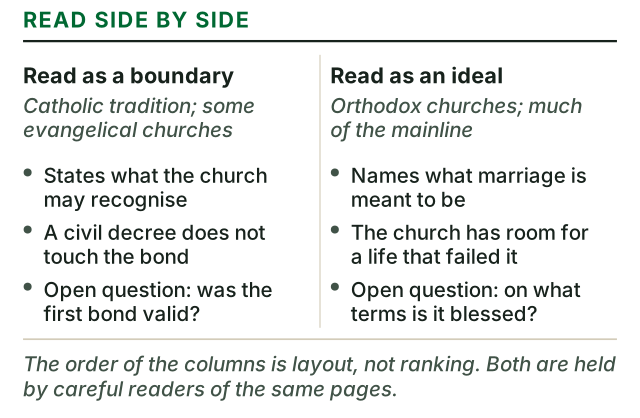
Read side by side
The exception clause, read two ways
Matthew records an exception the other Gospels do not. Everything downstream — annulment, economy, pastoral discretion — depends on what that exception is doing.
It narrows an ideal
Read this way in stricter traditions, Catholic and some evangelical
On this reading the exception does not open a door to remarriage. It permits separation in a grave case, or it describes a union that was never valid, while the bond of a real marriage stays intact for as long as both spouses live.
Mark and Luke are treated as the plain form of the teaching, and Matthew as a clarification within it — which is why this reading resists using the exception as a general permission.
It states a real exception
Read this way in Orthodox practice and across much of Protestantism
On this reading the exception means what it appears to mean: unfaithfulness can end a marriage, and the innocent party is not bound to a marriage that no longer exists. Desertion in Paul's letter is read alongside it as a second such case.
Practice built on this reading is rarely permissive in tone. Orthodox churches speak of economy — mercy applied to a broken situation — and second marriages are often blessed with a penitential rite rather than a wedding.
Who reads it which way?
Positions cluster, though no tradition is perfectly uniform inside itself.
The Catholic framework holds a valid sacramental marriage indissoluble, which moves the question from “may I remarry” to “was the first marriage valid.” That is what a tribunal examines, and a declaration of nullity is a finding about the past, not a permission slip.
Orthodox churches hold the same ideal but keep pastoral room beneath it. Economy is the language used for that: mercy applied to a situation already broken, rather than approval of the divorce itself. Divorce is treated as a death the church acknowledges rather than an act it approves, and a second marriage may be blessed under that language, often with conditions.
Evangelical and independent churches vary the most, because authority sits with the local congregation and its reading. Two churches on the same street can teach opposite things about the exception clause with equal conviction.
Mainline Protestant churches generally recognise civil divorce and will marry divorced people, with premarital conversation rather than a tribunal, though individual clergy retain discretion.
Three frameworks, equal weight
What each tradition is actually deciding
Traditions are not simply stricter or looser. They ask different questions, and each question has its own logic.
Was the first marriage valid?
The Catholic question
Consent, capacity, freedom and intent are examined. If the bond was validly made, it stands; if it was not, there was no marriage to dissolve.
What does mercy require here?
The Orthodox question
The ideal is unchanged, but a broken situation is met pastorally. A second marriage is permitted as a concession, and the rite carries that mood.
What does the text permit?
The question across Protestantism
The exception clause and Paul's case are read directly, and the answer follows the reading — which is why Protestant practice ranges from strict to open.
Does the Bible treat widowhood differently from divorce?
Yes, and the distinction removes a lot of confusion. Where Paul discusses a widow, remarriage is described as open, with the ordinary counsel of the letter attached. No mainstream tradition disputes the remarriage of a widowed person, which is why a widowed reader and a divorced reader can sit in the same pew under very different rules.
That is worth knowing if you are being told a blanket claim about second marriages. Nearly every restriction in this argument attaches to a first spouse who is still living. When someone quotes a verse at you about remarriage, the first useful question is which case the verse is addressing. For example, a line addressed to a widow and a line addressed to a divorced woman are doing quite different work.
Does the Bible say a remarried person is living in ongoing sin?
This is the sharpest form of the question, and it is where the readings hurt rather than interest people. One reading treats a second marriage as a continuing state that the church addresses; another treats the divorce as a past act, forgiven like any other, with the new marriage a real marriage from its first day. Both are held by serious people. The is remarriage adultery page sets out how each gets there from the text.
If the weight you are carrying is guilt rather than doctrine, that is a different conversation, and guilt about remarriage is where we keep it.
What this page will not do
A page that ruled on this would be pretending to an authority it does not have.
- Tell you whether you may remarry
- That answer belongs to your tradition and to the person who pastors you, not to a website that has never met you.
- Rank the traditions
- We describe where each stands and what it stands on. Whether one is more faithful than another is exactly the argument we are describing, not one we join.
- Translate for you
- Where a Greek or Hebrew word carries the dispute, we say so and name it. We do not offer our own rendering as if it settled anything.
- Repeat folk rules as scripture
- The waiting period, the one-permitted-divorce rule, the idea that a second marriage cannot be blessed anywhere: these circulate as folklore, not as text or as any church's stated teaching.
What we do stand behind
- Naming the passage
- Book and chapter, so you can check anyone who tells you what the Bible says — including us.
- Naming the reading
- Each position stated in its strongest form, the way someone who holds it would recognise.
- Naming who holds it
- Positions come from communities with histories. Attributing them is more honest than presenting one as the plain sense.
Where this page stops
An article can prepare a conversation. It cannot have it. The decision about whether you can marry again inside your faith is made with the person who has authority in your tradition — a pastor, a priest, a confessor — and it is worth asking them plainly rather than assembling an answer from search results.
Two practical notes before you go. Bring the question early, before a date is booked; and ask what your church requires as a process, such as a meeting, a review or a period of preparation, not only what it believes. Those are different answers and both matter.
If the conflict has stopped being theological and started keeping you awake — if you are carrying shame that follows you into ordinary days, or the fear of being cut off from your community is overwhelming — that is worth a therapist as well as a pastor. If you are in crisis, contact a helpline in your country. The faith and remarrying hub holds the rest of these pages, and the positions by denomination comparison is the fastest way to see where your own tradition sits.
You will not find your answer at the bottom of a page. You will find it in a room with someone who knows both the tradition and you.