
The person asking whether a Christian can marry a divorced person is usually not the divorced one. They have met someone, it is going well, and then a verse or a relative or their own conscience put a question in the middle of it.
Can a Christian marry a divorced person is a question about the standing of a first marriage rather than about the character of the person who was in it, and Christian traditions answer it differently. This page does not answer that question with a yes or a no, because Christians have never agreed on one and a website is not the body that decides. What it does is show the texts the argument runs through, the two ways those texts are read, and where the major traditions stand — so you can walk into the conversation with your own clergy knowing what is actually being debated.
Can a Christian marry a divorced person?
Traditions answer differently, and every one of them answers by asking about the first marriage rather than about the divorced person’s character.
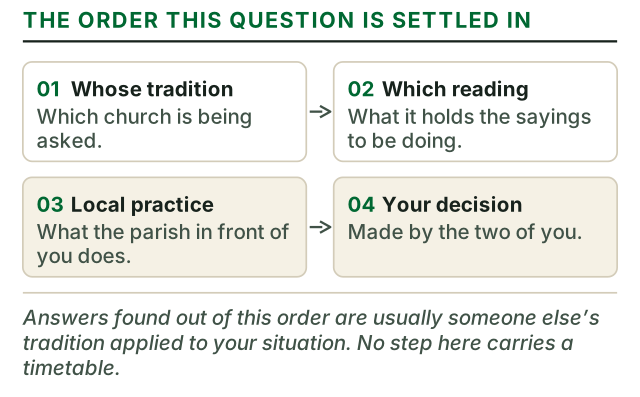
That is the single most useful thing to understand early. Nobody serious is assessing whether your partner is worthy, repentant enough, or spiritually damaged. For example, a priest asking about the first wedding day is asking what was consented to then, not how your partner behaves now. The question being asked is narrow and technical: is that earlier marriage still a marriage in the eyes of this church? Everything else follows from the answer.
Where the first marriage is held to be still binding, a new wedding cannot be recognised while both former spouses live. Where it is held to have genuinely ended, the divorced person is free to marry and the question closes. The disagreement sits at that hinge, and it is old.
Which texts is this argument built on?
A small set, which is why the discussion feels so concentrated and why the same passages come back at you from both directions.
The sayings on divorce and remarriage sit in Matthew, chapters five and nineteen; in Mark, chapter ten; and in Luke, chapter sixteen. Paul returns to the question in First Corinthians, chapter seven, and touches it again in Romans, chapter seven. Behind all of them stands the Genesis language about one flesh, and the passage in Deuteronomy, chapter twenty-four, that the Gospel arguments respond to.
Two details drive the split. The exception clause is the qualifying phrase Matthew’s version carries and the Mark and Luke versions do not, usually rendered as sexual immorality or unfaithfulness. And Paul addresses a case the Gospels do not obviously cover: a believer whose unbelieving spouse departs.
The particular line that lands on people asking this question is the one about a man who marries a woman who has been divorced. It is the sharpest phrasing in the set, and it is read in two quite different ways.
How is “marrying a divorced woman” read?
As a rule covering every divorced person, or as a judgement on a specific kind of dismissal. Those two readings produce every position you will encounter.
The two readings, side by side
What the saying about marrying a divorced person is taken to mean
Both readings are held by people who have spent their lives with these texts. Neither is a loophole and neither is cruelty.
The stricter reading
Held where the first bond is treated as unbreakable while both former spouses live
The saying means what it appears to say: to marry a person whose spouse is still living is to enter an adulterous union, because the first bond was never dissolved by a court or by a separation. The Matthew exception is read narrowly — as permission to separate rather than permission to marry again, or as covering a union that was never a marriage in the first place.
On this reading, the difficulty is not the wedding day but the state that follows it. That is why pastoral conversations in these traditions are long, and why they focus on the history of the first marriage rather than on the couple standing in front of the priest.
The wider reading
Held where divorce is treated as able to end a marriage in fact
The saying is read as confronting a practice of the time: a man dismissing a wife casually, leaving her without protection or standing, and another man taking advantage of that. On this reading it protects the discarded woman rather than barring her from ever marrying again.
The Matthew clause is taken as a genuine exception and Paul's case of desertion as a second one. A marriage that has truly ended is ended, and the person freed by it may marry — the betrayal named as adultery being the one that broke the first marriage, not the second wedding.
A longer walk through the passages themselves sits on what the Bible says about divorce and remarriage, and the harshest version of the question — whether the second marriage itself counts as adultery — is handled separately in this hub.
Where do the major traditions stand?
In recognisably different places, reached by different machinery rather than by different levels of seriousness about the text.
Three traditions, equal weight
How each tradition approaches marrying a divorced person
Described, not ranked. Each has internal variation, and a local parish or congregation may practise more gently or more strictly than the formal position suggests.
Catholic
Rome
A valid sacramental marriage is held to be indissoluble while both spouses live, and a civil divorce does not end it. So the question asked of your partner is not whether they may marry again, but whether that first marriage was valid — the matter a declaration of nullity examines.
Without such a declaration, a Catholic wedding will not proceed and a civil ceremony is not recognised as sacramental, which affects standing for Communion. The process, and what it does and does not claim, is described on our annulment page.
Orthodox
The Orthodox churches
Marriage is held unbreakable in principle, while the church may recognise that a particular marriage has died. Under the principle usually called economy, a second marriage can be blessed, using a rite whose penitential tone differs from a first wedding.
That path normally involves an ecclesiastical review of the earlier marriage and the bishop's permission. It is not framed as approval of divorce, but as the church meeting human failure without pretending it did not happen.
Protestant
Evangelical, Reformed and mainline congregations
Positions run the full width. Many hold that the Matthew clause and Paul's desertion case create real grounds, and will ask how the first marriage ended — whether there was unfaithfulness, desertion, or abuse — before agreeing to officiate.
Some hold the stricter reading with no exceptions. Mainline denominations often leave the judgement to the local pastor, which is why two churches in the same town can give a couple opposite answers.
A declaration of nullity is a Catholic tribunal’s finding about the beginning of a marriage — that consent was not validly given on the day — rather than a ruling that a marriage has since ended.
The side-by-side version of all of this is on positions by denomination.
Does it matter how the first marriage ended?
In most traditions that permit remarriage at all, yes — that is precisely the question their clergy will ask, and it is worth being ready for it.
Grounds are the specific reasons a tradition accepts as having genuinely ended a first marriage, such as unfaithfulness, desertion by a spouse who did not share the faith, and, in many contemporary congregations, abuse. Some churches also ask whether the divorced person sought the divorce or received it, and what was done afterwards.
This can feel like being put on trial for something painful, particularly when the person answering was the one left. It helps to know in advance that the questions are procedural rather than personal, and to ask the clergy directly what they will need to know and why.
Where the first marriage is examined for validity rather than for grounds — the Catholic route — the questions go to what was understood and intended at the original wedding rather than to what went wrong afterwards.
What if you have never been married and your partner has?
Then you are carrying a version of this question that rarely gets addressed directly, and it deserves naming.
You may be hearing from family that you are taking on someone else’s history. You may be wondering whether a church that receives your partner warmly will still quietly regard your marriage as second-tier. Those are not paranoid thoughts; congregations do differ, and some are warmer in principle than in practice.
The workable move is to find out early rather than late. Ask the specific church, not the internet, and ask before a date is set — for instance, whether they will officiate, on what conditions, and how the marriage will be regarded afterwards. A clear no in advance is easier than an ambiguous yes discovered at the rehearsal.
If a church has already declined, the options that remain — and how couples handle the family conversation afterwards — are covered in when a pastor won’t marry you.
What if the two of you read this differently?
Then there are two problems wearing one coat, and separating them takes some pressure off both.
The first is theological: which reading is correct. That does not get settled at a kitchen table, and attempting it there tends to become a contest over who takes God more seriously, which nobody wins.
The second is practical and genuinely yours: which church you attend, what you say to parents, whether one of you will belong somewhere that does not fully receive the other. Couples who hold this well tend to stop trying to convert each other and start naming what each of them actually needs — a blessing, a clear conscience, a place to belong, an end to the arguing.
Where this page stops
Here, deliberately, and short of the answer you came for.
We do not know your partner’s first marriage, your tradition, or what was done to whom. Nothing on this page is permission and nothing on it is prohibition. Anyone handing you either one from a search result is overreaching, in either direction.
The people who can answer for your situation are your own pastor, priest or minister, and your partner’s — asked directly, with the specifics, and with a second question allowed. If you are afraid of the answer, say that out loud in the room. It is a normal thing to bring, not a disqualification.
If this question has stopped being a question and started pressing on your sleep, your appetite or your sense of being worth anything, that is the point to add a therapist alongside the clergy conversation. Some counsellors work specifically with religious conflict and will not push you out of your faith to relieve it. If you are in crisis or thinking about harming yourself, contact a helpline in your country now, before you read anything else.
More questions held the same way sit in our faith and remarrying hub.