
People rarely type is remarriage adultery into a search box out of curiosity. They ask after a conversation with a parent, a pastor, or a verse someone forwarded them — usually about a marriage that already exists, or a wedding that is already planned.
Is remarriage adultery is a question about how a short set of Gospel sayings should be read, and it is not one an outsider can settle on your behalf. So this page does two things and refuses a third. It shows where the phrase comes from textually. It shows how different Christian traditions read those same lines. It does not tell you which reading is true, because that is not something an article can honestly hand you.
Where does the phrase “is remarriage adultery” come from?
It comes from a small set of sayings in the Gospels, plus two passages from Paul. Almost the entire argument runs through those places, which is why the discussion feels so concentrated and so sharp.
The sayings on divorce and remarriage sit in Matthew, chapters five and nineteen; in Mark, chapter ten; and in Luke, chapter sixteen. Paul returns to the question in First Corinthians, chapter seven, and touches it again in Romans, chapter seven.
Two features of that set drive everything that follows. The exception clause is the qualifying phrase the Matthew version contains and the Mark and Luke versions do not. And Paul addresses a case the Gospels do not obviously cover: a believer whose unbelieving spouse leaves.
Everything you have ever heard on this subject, from either direction, is an attempt to hold those pieces together. For example, a preacher quoting Mark alone and a counsellor quoting Matthew alone are working from the same short list. Nobody is ignoring the text. They are weighting it differently.
Did Jesus say remarriage is adultery?
He is recorded using the word, and the traditions divide over what the word is doing in the sentence. That is the honest summary, and it satisfies neither side.
The two readings, side by side
What the Gospel sayings are taken to mean
Both readings are held by serious people who have spent their lives with these texts. Neither is a loophole and neither is cruelty.
The stricter reading
Held where the first bond is treated as unbreakable while both spouses live
The saying means what it appears to say: a spouse who divorces and marries another enters adultery. The exception clause in Matthew is read narrowly — as permission to separate rather than permission to remarry, or as covering an irregular union that was never a marriage.
On this reading, the state of the second marriage matters more than the moment of the wedding. Remarriage is not one past act to confess but a situation that continues, which is why pastoral conversations in these traditions can be long and difficult.
The wider reading
Held where divorce is treated as able to end a marriage in fact
The saying is read as confronting a specific practice — casual dismissal of a wife, leaving her without protection — rather than issuing a rule that covers every dissolved marriage. The Matthew clause is read as a genuine exception, and Paul's case of desertion as a second one.
On this reading, a marriage that has truly ended is ended, and freedom to marry again follows. Adultery names the betrayal that broke the first marriage, not the second wedding of a person whose marriage was already destroyed.
Why do the Gospel accounts differ, and does that matter?
It matters more than any other single detail, because the exception clause is where the two readings physically part company.
Matthew’s version qualifies the saying with a term usually rendered as sexual immorality or unfaithfulness. Mark and Luke record the saying without it. Readers who treat the shorter form as the fuller teaching conclude that Matthew is clarifying something narrow. Readers who treat Matthew as reporting the whole saying conclude that a real exception was always there.
Paul’s passage in First Corinthians adds a further case: when an unbelieving spouse departs, the believer is described as not bound. The Pauline privilege is the formal category some traditions built on that sentence. Others read it as counsel for one situation in one city.
None of this is a modern invention or a recent softening. The argument over these same words is old, and the lines were drawn long before anyone reading this was born.
How do different traditions actually stand?
They stand in recognisably different places, and they arrive there by different machinery rather than by different levels of seriousness.
Three traditions, equal weight
Where the major traditions land
Described, not ranked. Each of these has internal variation, and a local parish or congregation may practise more gently or more strictly than the formal position suggests.
Catholic
Rome
A valid sacramental marriage is held to be indissoluble while both spouses live, and civil divorce does not end it. The question asked is therefore not whether remarriage is permitted, but whether the first marriage was valid at all — which is what a declaration of nullity examines.
Where no declaration exists, a civil remarriage is not recognised as sacramental, and this affects standing for Communion. Pastoral care of remarried Catholics has been actively discussed at the highest levels in recent decades.
Orthodox
Constantinople and the other Orthodox churches
Marriage is held unbreakable in principle, while the church may recognise that a particular marriage has died. Under the principle usually called economy, a second marriage can be blessed — with a penitential rite whose tone differs from a first wedding.
This is not framed as approval of divorce. It is framed as the church meeting human failure without pretending the failure did not happen.
Protestant
Evangelical, Reformed and mainline congregations
Positions run the full width. Many hold that the Matthew clause and Paul's desertion case create genuine grounds on which remarriage is lawful. Some hold the stricter reading with no exceptions. Mainline denominations often leave the judgement with the local pastor.
Because authority sits closer to the congregation, the answer you receive can differ between two churches in the same town — disorienting, when you have been told there is only one biblical view.
Economy is the Orthodox term for a rule that stands while the church acts beneath it, which is how a second marriage can be blessed without divorce being approved.
For the longer walk through the texts themselves, see what the Bible says about divorce and remarriage; for the traditions laid out in one place, see positions by denomination.
Is remarriage a sin, or was the sin the divorce?
This is the split that causes most of the private pain, and it stays invisible until someone says the quiet part.
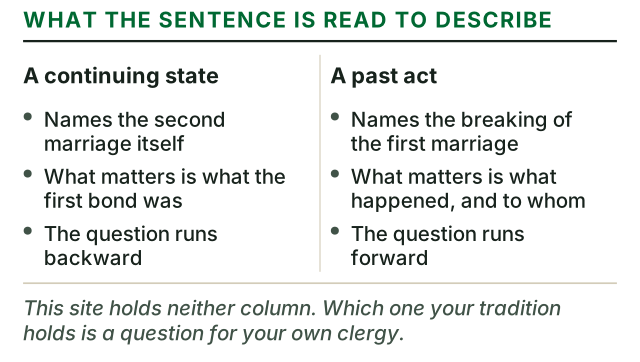
One reading treats remarriage as an act located in the past: a wedding day, a decision, something repentance can close. The other treats it as a state that continues for as long as the marriage does. The same word, sin, means two very different practical things depending on which reading your church holds.
That difference explains why, for example, one person is told to make peace with it and move on while another is told there is something ongoing to address. Neither person is being lied to. They are inside different systems.
If you are carrying this as guilt rather than as a question, that is a separate weight and it responds to different care. We wrote about it in guilt about remarriage.
What if my partner and I read this differently?
Then you have two problems that look like one, and separating them helps.
The first is theological: which reading is right. That does not get settled at your kitchen table, and attempting it there tends to turn into a contest over who loves God more, which nobody wins.
The second is practical, and it is genuinely yours: what this household does on Sunday, what you tell the children, whether one of you attends a church that will not fully receive the other. That conversation is the one worth having.
Couples who hold this well usually stop trying to convert each other and start naming what each of them actually needs, such as a blessing, a clear conscience, a place to belong, or permission to stop arguing. Those needs can sometimes be met even while the underlying question stays open.
Where this page stops
Here, and deliberately.
We do not know your first marriage, your tradition, or what was done to you or by you. Nothing on this page is permission and nothing on it is prohibition. Anyone offering you either one from a search result is overreaching.
The person who can answer for your situation is your own pastor, priest, minister or rabbi — someone who will hear the specifics and can be asked a second question. If you are afraid of the answer, that fear is worth saying out loud in the room. It is a normal thing to bring, not a disqualification.
If this question has stopped being a question and started pressing on your sleep, your appetite or your sense of being worth anything, that is the point to add a therapist alongside the clergy conversation. Some counsellors work specifically with religious conflict and will not push you out of your faith to relieve it.
If you are in crisis or thinking about harming yourself, contact a helpline in your country now, before you read anything else.
More of these questions, held the same way, sit in our faith and remarrying hub.