

Most people looking up Christian denominations on divorce and remarriage are not doing comparative theology. They are trying to find out whether the church they sit in on Sunday will marry them, and what it will quietly think of them afterwards. That question deserves a straight description rather than a sermon.
Christian denominations on divorce and remarriage are traditions reading one short list of texts and reaching different conclusions about what a church may do once a marriage has ended. This page sets the main positions beside each other at equal weight. It does not rank them, recommend a tradition, or hand out permission — none of those are things a website is entitled to do.
What do the denominations actually disagree about?
Less than you would expect about which texts matter, and much more about what a church can do once a marriage has already ended.
Nearly every tradition works from the same short list: the gospel sayings on divorce in Matthew and Mark, the exception clause in Matthew, Paul’s instructions to the Corinthians about a believer deserted by an unbelieving spouse, and the passage in Malachi usually rendered as God hating divorce. Almost nobody disputes that these are the relevant places.
The divergence comes at the next step. Is marriage a bond that human decisions cannot dissolve, or a covenant that human betrayal can break? If it cannot be dissolved, is there a way to find that a particular marriage never truly formed? And when a congregation is full of people whose marriages have already ended, is the church’s task to apply the rule or to carry the person?
Each tradition answers those three questions in a different order. The visible differences — tribunal paperwork, a penitential wedding rite, a pastor’s private discretion — are downstream of that ordering.
Where does each tradition stand?
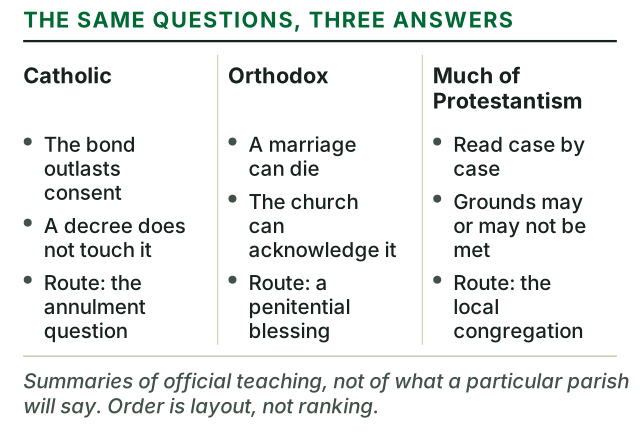
Each tradition stands on a different prior question, and the table below sets those questions and their consequences side by side without ranking them.
| Tradition | What happens to the first marriage | The usual route to a church wedding | Where the internal argument sits |
|---|---|---|---|
| Roman Catholic | A valid, consummated marriage is held to be indissoluble while both spouses live | A tribunal examines whether the marriage was validly formed; a declaration of nullity, if granted, clears the way | Pastoral care of the divorced and civilly remarried, and access to communion |
| Eastern Orthodox | Divorce is recognised as a real death of the marriage, treated as a failure rather than a right | A bishop may permit a later marriage by economy, often with a more penitential wedding rite | How freely economy should be applied, and how much practice varies between jurisdictions |
| Anglican and mainline Protestant | The first marriage is generally accepted as ended | Usually possible, with pastoral discretion resting on the local minister or bishop | How much discretion an individual minister should hold, and on what grounds |
| Evangelical and Baptist | Depends on the reading of the exception clauses; there is no single position | Set congregation by congregation, sometimes pastor by pastor | Whether adultery and desertion are the only grounds, and whether they permit remarriage or only separation |
| Stricter conservative churches | The first bond is held to persist while the former spouse lives | No church remarriage; some ask a couple already remarried to change their situation | Whether a couple who remarried before conversion is treated differently |
Two warnings about reading that table. First, the spread inside a tradition is often wider than the gap between traditions: two Baptist churches in the same town can, for example, hold opposite positions, and two Catholic tribunals can differ in pace and tone while applying the same law. Second, the third column describes a route, not a likelihood — nothing here predicts what a particular church will decide about you.
Why does the Catholic Church talk about annulment rather than divorce?
Because in Catholic teaching the question is not whether to end a marriage but whether one was ever formed.
A declaration of nullity is a finding about the beginning, not the end: that at the moment of consent something essential was missing, such as capacity, freedom, honesty about a decisive matter, or the intention to marry as the church understands marriage. It is not, in this framework, a divorce with religious wording. Describing it that way is what makes the process look dishonest to outsiders and feel insulting to the people going through it.
The part people underestimate is emotional rather than procedural. Being asked to reconstruct the state of your own mind as a much younger person, in front of a tribunal, while the children of that marriage are in the next room, is a strange and often painful task. The common fear that those children are somehow being declared illegitimate is one the church explicitly rejects — worth knowing before the worry sets in.
Whether the process is right for you is a conversation with your parish. The paperwork side belongs to your diocese; the part this site can sit with is the guilt people carry into it.
What does the Orthodox Church mean by economy?
That the rule stands, and that the church may act pastorally within it when applying it rigidly would crush the person it was meant to protect.
Economy is the name for that pastoral room: a concession a bishop may grant, not a right a couple can claim.
Orthodox practice does not pretend the first marriage never happened. It treats divorce as a genuine failure and a wound, then allows a bishop to permit a subsequent marriage as a concession to human weakness. That is why the rite used is often more subdued and penitential in tone than a first wedding — the sorrow is written into the ceremony rather than edited out of it.
Depending on where you stand, that combination reads as the most honest of the approaches or the most uncomfortable. Both reactions are common, and neither is a misunderstanding of what is being done.
Why do evangelical churches reach opposite conclusions from the same verses?
Because the disputed phrases are genuinely ambiguous, and each choice about them cascades into everything that follows.
The exception clause is the qualifying phrase Matthew’s version carries and Mark and Luke do not, and almost the whole evangelical disagreement turns on how widely it is read.
The same verses, read three ways
Where the exception clauses split
These are the readings that actually divide congregations, set out as positions people hold rather than as options to pick from.
The strict reading
Held in stricter conservative churches, and by a minority in most others
The plainest form of the saying, in Mark and in Luke, carries no exception at all. On this reading the clause in Matthew covers unfaithfulness during the betrothal period, or permits separation without permitting a new marriage.
The consequence is heavy, and the people who hold it know that: a divorced person is not free to marry again while the former spouse lives, whatever the civil courts say.
The exception reading
Common across evangelical, Baptist and many mainline churches
Matthew's clause is taken as a real exception. Marital unfaithfulness breaks the covenant, and the wronged spouse is free — free to marry again, not merely to separate.
The argument then moves to definitions: what counts as unfaithfulness, whether an unrepentant pattern qualifies, and whether the reading protects the injured party or supplies a loophole.
The desertion reading
Drawn from Paul's letter to the Corinthians
Paul's instruction about a believer abandoned by an unbelieving spouse is read as a second ground, on the basis that the deserted person is not bound.
Churches then argue over its reach: whether it applies only where faith is the reason for leaving, and whether abandonment can include a spouse who never physically left.
Two things sit outside those columns. Mainline Protestant bodies — Methodist, Lutheran, Presbyterian, Episcopal and others — have largely moved the decision from the denomination to the minister, so the exegetical debate happens less at the pulpit and more in a private meeting about whether this particular couple will be married in this particular building.
And in many non-denominational churches there is no written position to look up at all. There is a pastor, and there is whatever that pastor has concluded, which is why the same question gets three answers within one city. Our companion pages walk through the texts themselves and the sharpest version of the question.
What if the two of you come from different traditions?
Then the disagreement stops being abstract and starts sitting at your kitchen table, usually disguised as an argument about a venue.
Consider the catholic vs protestant remarriage situation, the common one: one person needs a tribunal process before anything can happen in their church, while the other’s church would marry you next month and cannot see the obstacle. Underneath the logistics is something harder. Each of you is being asked to treat the other’s conscience as either an obstacle to be worked around or a fact about the person you love.
The emotional half
What this feels like, and what couples do with it
What it feels like
Described often by people in mixed-tradition couples
Like being asked to choose between the person and the tradition, with whoever bends first becoming the one who gave up their faith for a wedding.
There is usually a quieter fear underneath: that a church's position is a verdict about your character, and that the people in the pews reached it before you walked in.
What couples do with it
Not a prescription; the range of what people describe
Separating the two questions helps more than anything else. What does each church require, and what does each of you actually believe? The answers are rarely identical, and the conversation improves once they are pulled apart.
Many speak to both clergy separately before deciding anything together, so that neither person is relaying — and unconsciously softening — the other tradition's answer second-hand.
Where this page stops
Right here, and deliberately.
This page can tell you what the traditions hold and why they differ. It cannot tell you what your church will decide, whether your marriage can be declared null, whether you are forgiven, or which tradition has it right. Those questions belong to a priest, pastor or tribunal who knows your situation — and a good one will not be offended that you arrived with the comparison already in hand.
Two other routes are worth naming plainly. If a faith conflict is running through your marriage rather than around it, a counsellor who works with couples on religious difference — faith-affiliated, if that matters to you — does work that no article does.
And if the guilt has become constant, sleepless or hopeless, that is not a theological problem to be solved harder. Contact a therapist, your doctor, or a helpline in your country.
The rest of these questions, including how each tradition handles them in practice, sits in the faith section.