
Dealing with a partner’s ex is nearly always misfiled as a problem about the ex. It is usually a problem about how a marriage handles a third party it did not choose and cannot remove: a calendar that belongs to two households, a phone that rings at dinner, a history your partner has and you do not.
This page is the frame for the section. It sets out what former partners actually bring into a second marriage, what a couple can and cannot decide about it, and which page here covers which part. What you will not find in this section: scripts for managing an ex, tactics, or a case for treating a former partner as a villain.
Why does a partner’s ex affect a marriage this much?
Because a second marriage with children in it has more members than two, and the extra members are not optional. Decisions get made in another house and arrive in yours as consequences — a changed weekend, a cancelled plan, a mood that walks in the door at six.
Co-parenting is the ongoing logistical relationship between two former partners who share responsibility for a child, and it does not end because one of them remarries. That is the part most often mistaken for unfinished romance when it is simply unfinished parenting. For example, a long phone call about a school decision and a long phone call about nothing look identical from the next room, and only one of them is about the marriage.
The everyday version of this is described in his ex-wife and me, and the patterns people read as jealousy are in signs an ex is jealous.
What is a boundary here, and whose is it?
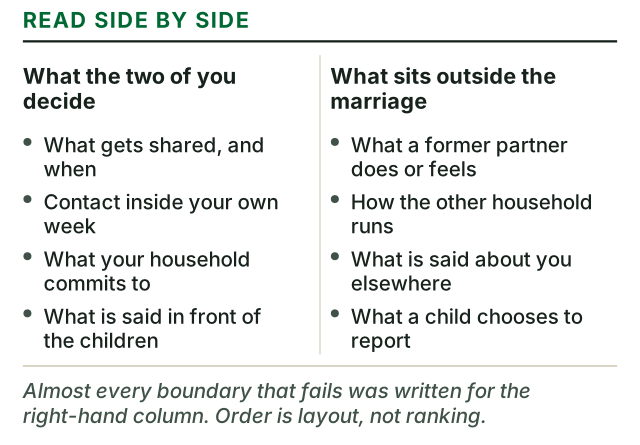
A boundary is an agreement about your own household’s behaviour, and it belongs to the couple rather than to the ex. That distinction is the difference between something workable and something that becomes a second front.
A boundary is a statement of what you and your partner will do, not a rule issued to someone who never agreed to it — the framing Nedra Glover Tawwab works through at length in Set Boundaries, Find Peace. Applied here it means agreements such as when logistics get handled, what is shared between spouses, and what conversations happen with the door open. Consider the difference between “she must stop texting after nine” and “we don’t take non-urgent calls during dinner”: the first depends on a person outside your marriage, and the second does not.
The page for this is boundaries with exes.
Why does jealousy show up even when nothing is happening?
Because a former partner occupies a category the mind treats as significant regardless of the current facts, and because the information you have is always partial. You hear one side of a call and none of a history.
Attachment insecurity refers to a heightened sensitivity to signals of a partner’s availability, and it is a normal dimension of adult closeness rather than a fault line — the four-category description worked out in Bartholomew and Horowitz’s model of adult attachment is the standard vocabulary for it. In a second marriage that sensitivity has an obvious target standing in the room. Imagine how much of an evening can be spent reading a tone of voice that had nothing in it.
None of that means a feeling is imaginary. It means the feeling is information about you as often as about the other household, and both readings deserve the same weight.
What does a couple actually control?
Their own conduct, the information that moves between them, and whether the marriage is a single unit when a decision arrives. That is a short list, and it is the whole list.
What tends not to work is any plan aimed at the other household: correcting the record, winning a comparison, or managing a person who is not in the conversation. A competition with someone who is not competing has no finish line, and the effort is visible to everyone in the house, including children. The wider version of this is in protecting the marriage, and the hardest version — a former partner whose behaviour is genuinely difficult — is in when the ex is toxic.
Where this section stops
These pages describe patterns. They do not assess anybody’s ex, and they cannot tell from here whether what you are living with is ordinary friction or something colder, because the person in question is outside our knowledge entirely.
Take it to a family therapist if the strain is constant or if it has become the main subject of your marriage; take it to a lawyer if the dispute is about custody, money or an order. If anyone in the situation is being frightened, controlled or coerced, or if a child is being used to carry messages, that is not a boundary question and it deserves someone trained to hear it.