Feeling second place in a blended family is one of those experiences people describe carefully, in the third person, as though it belonged to somebody else. It sounds ugly said plainly: I want to matter more than his children do. That is not the request underneath it. The request is closer to I am not sure I am anywhere on the list.
This page describes the pattern. It does not assess your partner, their former spouse, or any child in your house, and it is not a test you can pass or fail.
What does “feeling second place” actually describe?
It is usually three separate things arriving together: a partner whose attention is claimed first by his children, a home with rituals formed before you got there, and no protected place in the week that belongs to the marriage.
Bundled, they feel like a verdict about your worth. Separated, they are three ordinary household problems, and only one of them is really about ranking.
That separation is the first useful move. “He puts them first” is unanswerable — a partner can only defend himself or apologise. “These plans changed, on these days” is a thing two adults can look at together.
Why does a stepparent end up feeling like an outsider at home?
Because a family is largely a shared history, and you were not in the earlier part of it.
The details are small and relentless. There is, for example, a way this household does Sunday. There is a joke nobody explains. There is a seat at the table with no name on it that is still, somehow, someone’s. There is a tone the children use with their parent that you will never be offered, because it was built over years you spent somewhere else.
None of that is exclusion by intent. It is what happens when one person joins a group that already exists. Being outside a history feels exactly like being unwanted, and people describe that as the hard part to argue themselves out of.
It also runs in a direction people notice less: children in these houses describe watching an outsider arrive in their history, which is the same complaint from the other side.
Two honest halves
Coming second: what it feels like, and what couples do with it
The feeling is not fixed by an arrangement, and an arrangement is not made unnecessary by naming the feeling. Both halves need attention.
What people describe feeling
Stepparents, in their own words
Being consulted about the house but not about the family living in it.
Watching a partner reach for the phone mid-sentence because a child's name appeared.
Having plans that hold for everyone except you.
Guilt about resenting a child, and therefore never mentioning the resentment to anyone.
A quiet suspicion that if it ever came to a choice, you already know the answer — and hating yourself for keeping score.
What couples often try
Common arrangements, not prescriptions
One slot in the week that belongs to the marriage and is not moved for anything short of an emergency.
An agreement that changes to plans are told to the spouse before they are agreed with anyone else.
Naming who decides what: household matters together, parenting decisions with the parent leading.
Time with each child separately, so the relationship is not only ever tested in the full-house version.
Saying the resentment aloud once, to the partner or to a therapist, instead of managing it privately for years.
Is “my husband puts his kids first” a real problem or an unfair expectation?
Both descriptions get used, and the argument stays stuck because the sentence is doing too much work at once.
A parent who drops things when a child genuinely needs them is doing the thing you probably admired about him. Few people say they would want a partner who would not. So the complaint is rarely about priority in a crisis.
Putting the children first is a description of a parent turning toward a child who needs them, not a ranking of who matters in the marriage. What people are usually pointing at is narrower and more concrete:
- decisions about the household made with the children or the other parent, and reported to the spouse afterwards
- guilt-driven yes-saying, where a child’s preference outranks an adult agreement because saying no costs the parent too much
- an absence of any time that is reliably the marriage’s
- a partner who becomes visibly anxious when the children arrive and stops being available to anyone else
Those are different conversations, and each has a possible next step. “You put them first” has no next step. If you take one thing from this page, take the habit of naming which of them you actually mean.
The version where the two of you are on opposite sides of a specific child has its own page: when partners disagree about the children.
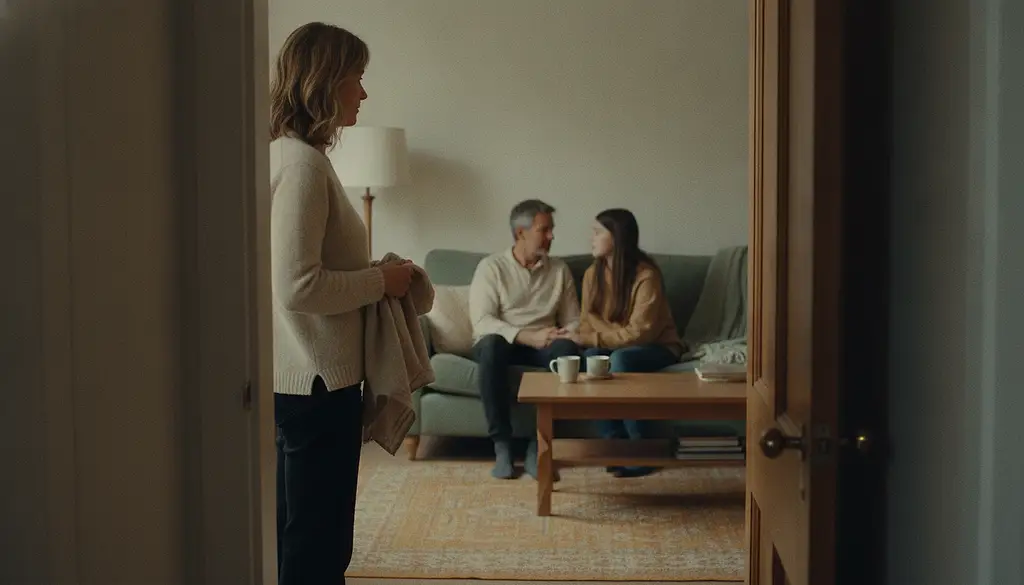
Why is this feeling so hard to say out loud?
Because saying it seems to require admitting you are competing with a child, and most people would rather carry it silently than be that person.
Unspoken resentment is the version of this feeling that is never said and never quite put down. It comes out sideways, later, attached to something small, such as a changed weekend or a forgotten dinner, and the disproportion in the reaction becomes the topic of the argument instead of the thing underneath it. The partner hears an overreaction to a schedule change. The stepparent hears that their feelings are excessive. Neither is lying.
There is also the shame layer, which is its own weight. Resenting a child feels disqualifying, and that is often where the silence starts. Amir Levine and Rachel Heller’s Attached, a general-reader account of adult attachment, is written around how adults voice, or avoid voicing, what they need from a partner. The silence is the part worth interrupting first, whether the listener is the partner, a friend who has lived in a stepfamily, or a therapist.
A related identity question — where you fit relative to a first wife who is still very much present in the family story — sits in being a second wife.
What do couples actually do about it?
Mostly small, boring, repeatable things, because the feeling responds to evidence and not to reassurance.
Reassurance is a statement about how someone feels rather than a change in what happens, and it is the trap here. “Of course you matter” is true and useless, and it is contradicted the next time a plan moves. What people describe changing the internal arithmetic is a pattern of ordinary events going the other way. For instance: a protected evening that keeps happening, being told about a schedule change first, or one decision where the marriage’s needs won without anyone being punished for it. The idea of watching what couples actually do over time, rather than what they report about each other, runs through Robert Levenson and John Gottman’s paper on physiological and affective predictors of change in relationship satisfaction.
Two things worth saying about that:
Small and kept beats large and aspirational. A grand agreement about priorities is hard to test. One evening a week is either honoured or it is not, and both of you can see which.
It goes both ways. Partners in this pattern describe carrying guilt about the children, fear of losing them, and a sense of failing everyone simultaneously. Couples describe a conversation that treats him as the defendant producing a defence rather than a change.
What this page does not recommend
Much of the advice written about this topic treats the household as a contest with a winner, and it makes homes colder.
We do not recommend ultimatums about a partner’s children, or asking anyone to prove where you rank. We do not recommend keeping a private ledger of who was chosen and when — it feels like evidence-gathering and functions as rumination. We do not recommend withdrawing warmth from a child to make a point to an adult. We do not recommend testing a partner with silence and waiting to see whether he notices.
We also do not recommend the language of stages and timetables, as though a household were behind schedule. The tidy intervals circulating online are folklore, not measurement, and treating them as a benchmark adds a second problem to the first.
And this page does not tell you what your partner feels. Nobody writing an article can see that. If you want to know where you stand with him, the route is asking him, not reading signs.
Where this page stops
This describes a pattern many stepfamilies recognise. It cannot see your household, and it does not diagnose anyone in it.
If the same conversation has repeated for months without moving, if you have stopped raising it because the argument costs more than the problem, if the resentment has started to reach the children, or if your own mood has been flat or low for a long stretch, that is the point to bring in someone trained rather than another arrangement. What stepfamily counselling involves covers how that work is structured and how people find a practitioner; a family doctor is a reasonable first door if you do not know where to start.
Where there is violence, fear, or any concern for a child’s safety, this is not a stepfamily problem and no article should be your source. Contact a domestic abuse or child protection helpline in your country and speak to a professional directly.
The rest of it — the tiredness, the guilt, the long work of joining a family that already existed — sits in the strain hub. Feeling second place is lonely, and it is more familiar than it feels from inside, and it is not the same thing as being unloved.