Blended family problems are the strains that appear when two family histories are asked to share one household. They are usually described as logistics — whose house, whose rules, whose weekend — because that is the version that fits in a checklist. The version people actually live in is quieter and harder to name: a home where everyone is behaving reasonably and nobody feels at ease.
This page is about that half. Not the arrangements, but the strain underneath them, and what people do with it.
What are the real blended family problems?
Four come up repeatedly: divided loyalty in the children, love that arrives at different speeds, a stepparent holding responsibility without authority, and a couple who discover they are on opposite sides of the same child.
Everything else tends to be a symptom. Arguments about screen time, chores or bedtimes are real arguments, but they get their heat from one of those underlying fault lines. Solve the bedtime and the heat moves somewhere else.
That is why blended family challenges resist practical fixes. A rota can be agreed in an afternoon. Loyalty cannot be scheduled.
Why do stepchildren resist a stepparent who has done nothing wrong?
Because a child’s warmth toward a stepparent can feel, to that child, like a betrayal of the parent who is not in the room.
Divided loyalty is that sense in a child that warmth toward a stepparent takes something from the parent who is not there to see it. It is the emotional territory of John Bowlby’s Attachment, the opening volume of Attachment and Loss, which describes how children form and defend their bonds with the adults who raise them.
This is worth saying plainly, because stepparents take the coldness personally and there is usually nothing personal in it. A child who liked you before the wedding and stopped afterwards has not re-evaluated your character. Your position changed. You went from your parent’s friend to a permanent fixture in a family the child did not choose and may still be grieving.
Resistance also has a shape that changes with age. Younger children, for instance, often attach quickly and then swing back after contact with the other household. Teenagers frequently opt out entirely, which reads as rejection and is often just the ordinary work of leaving home arriving early. Adult stepchildren can be the most distant of all, because they have their own version of family history and no daily reason to revise it.
None of that is a diagnosis of a child. It is a description of what people report, and it is one of the most familiar blended family issues there is.
Two honest halves
Blended family strain: what it feels like, and what households actually do
Naming the feeling does not fix the household, and fixing the household does not settle the feeling. Both halves need separate attention.
What it feels like
Described by people living in it
Being a guest in a home you pay for, with rituals that were formed before you arrived.
Loving your partner and quietly dreading the weeks the children are with you.
Watching your partner become a different, more anxious person the moment the children walk in.
Feeling ashamed of resentment toward a child, and therefore never mentioning it to anyone.
Grief you cannot place: for the family you had, or the simple one you assumed this would be.
What households do with it
Common arrangements, not prescriptions
Discipline stays with the biological parent while the stepparent builds a relationship first.
One protected slot of couple time that children, work and the other household do not get to move.
Separate time with each child, so attachment is not tested only in the full-house version.
An agreement that disagreements about a child are settled between the adults, not in front of one.
Permission, spoken aloud, for the stepparent to feel less than everyone expected them to feel.
Why does love arrive unevenly, and what does that do to a marriage?
Because affection is a relationship rather than a role, and it develops on its own timetable for each pair of people in the house.
Uneven affection is closeness that grows at one speed with one person in the house and at another speed with the next. A stepparent may, for example, be fond of one child and merely polite with another. A biological parent may simply love their own child more, and often feels guilty about something entirely ordinary. Children read all of this accurately and say nothing.
What people describe as corrosive is less the inequality than the pretending. Households that quietly acknowledge different levels of closeness tend to be calmer than households insisting everyone is equally cherished, because children can feel the gap between the statement and the room.
Wanting to feel more than you do is not a defect. Stepparents say it often, usually quietly, and it does not mean the marriage was a mistake.
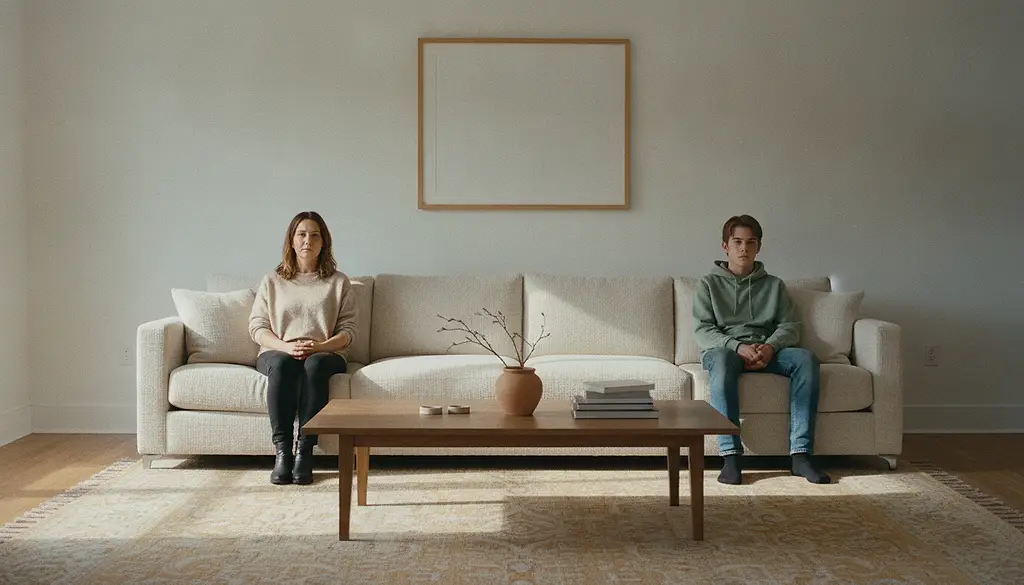
Why do couples end up on opposite sides?
Because each parent is fluent in their own child’s history and only half fluent in the other’s, and every disagreement about behaviour is really a disagreement about interpretation.
A divided couple is a pair of parents who have each become the advocate for their own child, so that any argument about behaviour turns into an argument about whose child is being judged. What couples do repeatedly, rather than what they say about each other afterwards, is the subject of John Gottman and Robert Levenson’s paper on marital processes predictive of later dissolution.
The pattern is recognisable. One partner sees rudeness where the other sees a child having a hard week. One wants a consequence; the other has spent years managing a fragile arrangement and does not want to spend capital on this. Both are acting in good faith, and both feel unsupported.
It matters because a divided couple is where ordinary stepfamily friction tends to harden. The children notice the split faster than the adults do, and some of them will use it — not out of malice, but because children test what is unstable.
That particular fault line has its own page: when partners disagree about the children.
Where does the other household fit into this?
It sits inside the marriage whether anyone invites it or not, and pretending otherwise costs more than acknowledging it.
Two homes with different rules is not a problem that gets solved; it is a condition to be lived with. Children move between them and adjust, sometimes more easily than the adults around them do. What people describe as lasting strain is less the difference in rules than the running commentary about it, such as the sighs at handover or the remarks made just within hearing.
The emotional side of that, including how couples agree what they will and will not carry, sits in boundaries with an ex. The formal arrangements — orders, schedules, who is entitled to what — are legal questions, and this site is not the place for them.
What this page does not recommend
A large share of stepfamily advice online is written to help someone win a household, and it tends to make the house colder.
We do not recommend demanding that a child call you a parental name, or waiting for the day they do. We do not recommend competing with the other parent for affection, keeping mental scorecards of who was thanked, or presenting your partner with an ultimatum about their own child during an argument. We do not recommend deciding what a child “really is” from a difficult year.
We also do not recommend the language of readiness tests and stepfamily stages as though they were a schedule you are failing. Households move at different speeds, and the tidy timelines circulating online are folklore, not measurement.
Where this page stops
This page describes patterns. It cannot see your household, and it does not assess anyone in it — not your partner, not their former spouse, and certainly not a child.
If the strain has become the normal weather of the house, if the same argument has repeated for months without changing, if a child has withdrawn in a way that worries you, or if you notice your own mood has been low for a long stretch, that is the point to bring in someone trained rather than another arrangement. What stepfamily counselling actually involves describes how that work is structured and how people find a practitioner. A family doctor is a reasonable first door if you do not know where to start.
Where there is violence, fear, or any concern for a child’s safety, this is not a stepfamily problem and no article should be your source. Contact a domestic abuse or child protection helpline in your country, and speak to a professional directly.
The rest of it — the tiredness, the guilt, the long adjustment of building a family out of people who did not choose each other — sits in the strain hub. Almost none of it is unusual, however lonely it feels at the time.