
It does not arrive as an insult. He compares me to his ex is a sentence people arrive at after something smaller and stranger than an insult. It follows a remark dropped in a kitchen about how she loaded the dishwasher, how she handled his mother, how she never minded the drive. Nothing hostile was said. Something still landed.
And the traffic runs both ways. The person being compared today is often, quietly, comparing too — this partner’s temper against the last one’s, this silence against that silence. Pages about this tend to pick a side and coach it. This one does not, because both halves tend to be happening at once.
What does it mean when a man compares you to his ex?
It tends to mean the previous marriage is still functioning as his baseline for normal, and the measuring is leaking into speech. Years of a shared life build a private standard for what an ordinary Tuesday looks like. That standard does not dissolve when the marriage does.
So the comparison is less about you than it sounds. For example, “she always did it this way” can be a person noticing that his own map no longer matches the ground.
That does not make it harmless. A comparison is heard as a ranking whether or not it was built as one, and being ranked in your own home is a specific kind of tired.
The useful question is not what one sentence meant. It is what the pattern does: whether comparisons run in both directions or only one, whether they show up in calm moments or only in fights, and whether they stop once you say they hurt.
Why does being compared to his ex wife hurt more than it should?
Because it touches the part of a second marriage that already feels provisional. That thought — being the sequel rather than the story — turns up on its own.
A comparison confirms that thought in someone else’s voice. It also arrives without a right of reply. You cannot correct the record about a marriage you were not in, and the other person is not there to be ordinary and flawed in front of you. She stays edited.
There is a second sting that people mention less. Being compared favourably can hurt as much as the other kind. For instance, “she would never have done this for me” places you inside a competition you did not enter, and it makes the affection feel conditional on staying ahead.
If that ache is closer to identity than to any single argument, it has its own page: first wife, second wife, and the part nobody says out loud.
Is it toxic when a partner compares you during a fight?
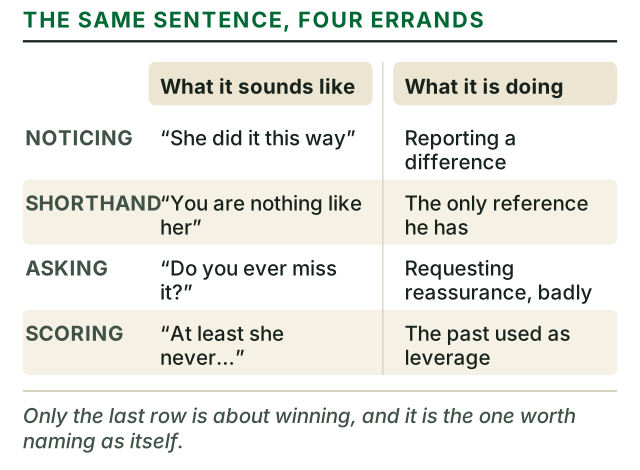
Not automatically, but it is doing a different job from a comparison over breakfast. A comparison made during conflict is usually a reach for leverage: a way to end the exchange by putting a verdict on the table that cannot be argued with.
Whether that is corrosive depends less on the words than on three things. Does it repeat after being named. Is it used to prescribe how you should behave. Does it always run in the same direction.
When all three are true, the marriage is not having a disagreement about dishwashers. It is having an unspoken conversation about whether the first marriage is finished, conducted in code.
Researchers who study couples in conflict work at the level of observable moves rather than of who was right. Matthew Johnson’s work on observing specific affect in marital interactions is about how those coding systems are built and checked — which behaviours get recorded, and how consistently. It is a method paper, and it has nothing to say about any particular argument in any particular kitchen.
Naming the code matters more than winning the argument it is hiding in. That is a conversation many couples find easier with a third person in the room, which is what stepfamily and couples therapy is actually for.
Both directions
Comparing to the ex: the two seats in the same room
Both columns tend to be in play at the same time. Setting them side by side keeps this from becoming a case against one person.
When you are the one compared
Described by people on the receiving end
A sentence lands as a score even when it was said as a fact.
You start pre-checking your own behaviour against a woman you have never met.
Silence becomes evidence: if he does not compare you today, you wonder whether he is thinking it.
Asking him to stop feels like asking him to censor his own past, so you say nothing and it accumulates.
When you are the one comparing
Described by people who catch themselves at it
The old marriage is still the only long comparison you own, so it supplies the measurements.
Comparisons that flatter the new partner slip out easily; the unflattering ones arrive during conflict.
You notice you are testing whether this person will do the thing the last one did.
Saying it out loud once tends to defuse it; saying it repeatedly tends to install it.
Is it toxic to compare your partner to your ex?
Privately, no: comparing is close to unavoidable, and treating the thought itself as a moral failure mostly adds shame to an already busy head. A private comparison is a thought that reaches for the only long marriage your memory owns and uses it as the reference set. That is how memory works, not a character flaw.
What changes the picture is what the comparison is asked to do. Held as a private observation, it fades. Spoken once, honestly, it can be information. Spoken as instruction — this is how it was done, this is how it should be done — it becomes a rule imported from a household this person never lived in.
There is also a version worth watching in yourself: comparing in order to stay safe. If a partner is being scanned continuously for resemblances to an ex, the scanning is more about a fear of repetition than about him. That fear has its own shape, and it does not resolve by finding differences fast enough. Hazan and Shaver’s paper conceptualising romantic love as an attachment process describes adult partnerships in the terms used for the bonds people form much earlier in life. That is the tradition this sort of scanning gets discussed in.
What do couples actually do about it?
Not much that is dramatic, and almost nothing that involves the ex-wife herself. She is not a participant in this. She is a person outside your knowledge who happens to appear in your partner’s sentences.
What tends to help is small and unglamorous, such as naming the specific sentence rather than the whole habit, close to when it happened, without a summary of every previous instance. Saying what it did to you rather than what it proved about him. Asking for the comparison to be finished in his own head rather than out loud, which is a request that can actually be met.
Scorekeeping is the habit of counting up wins against a person who is not playing, and it is the main thing that does not help, along with any plan aimed at outperforming her. A competition with someone who is not competing has no finish line, and the effort is visible to everyone in the house, including children.
If the comparisons are only one symptom and the ex-wife is a live daily presence in the marriage, the wider version of that strain sits in his ex-wife and me.
What if the comparison never stops?
Then the subject has changed. A pattern that survives being named, repeatedly and gently, is no longer about the dishwasher or the drive. It tends to be about grief, unfinished loyalty, or a marriage that ended legally and not internally.
None of that is diagnosable from a sentence, and this page will not try. It is also not automatically a reason to leave. It is a reason to stop negotiating alone about something one person cannot resolve by adjusting.
Where this page stops
This page describes a common pattern in second marriages. It does not assess your partner, and it cannot tell from here whether what you are living with is clumsy speech or something colder.
Take it to a couples or family therapist if the comparisons are constant, if they have become the main way conflict gets settled, or if you have started managing your own behaviour around a person you have never met. If the strain is affecting your sleep, mood, or ability to function, speak to a therapist or your doctor about that directly rather than filing it under relationship trouble.
If comparison is being used to control you — to dictate how you dress, who you see, or how you spend — or if any part of you is frightened of your partner rather than hurt by him, please contact a domestic abuse helpline in your country. That is a different question from the one answered here, and it deserves someone trained to hear it.
The rest of the doubts that come with marrying someone who was married before are gathered in the feelings hub. Being compared, and catching yourself comparing, puts you in very ordinary company.