

Working out how to trust again after divorce is not a matter of deciding to. People who ask the question have already decided; the trouble is that the decision does not reach the part of them that flinches when a phone goes face-down on a table.
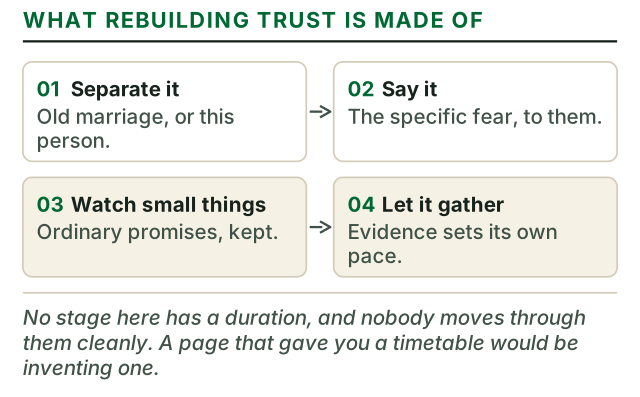
How to trust again after divorce is less a technique than a slow re-gathering of evidence, which is why nothing in it yields to deciding harder. The alarm went off late last time. It is not going to make that mistake twice.
Why is trust so hard after divorce?
Because trust was not lost as an idea. It was lost as a habit of not checking, and habits are rebuilt slowly. Trust issues after divorce are a recalibrated alarm rather than a broken belief.
Before a divorce, trust gets extended without anyone noticing it. Someone is late; the mind supplies traffic. Someone is quiet; the mind supplies a hard day. After a marriage ends, particularly one that ended in deception, those blanks stop filling themselves in. The mind offers a second explanation now, and then a third, and none of them are kind.
That is the real weight of it. The exhausting part is not suspicion of a new partner. It is the loss of the automatic, and the constant low-grade work of interpreting things that used to need no interpretation.
There is a second layer underneath, and people mention it less because it is more humiliating. What was damaged is not only trust in others but trust in your own reading of people. Someone who missed it once has to allow that they might miss it again, and that doubt follows you into every room, including the ones with no risk in them at all.
The habit of describing adults by what they expect from closeness has a long history in psychology. Kim Bartholomew and Leonard Horowitz’s four-category model of adult attachment is one of its standard references, and it offers descriptions of style rather than a diagnosis of anybody.
Two honest halves
Learning to trust again: what it feels like, and what people do with it
The feeling and the response are separate things. Set apart, they stop being one large verdict about your character.
What it feels like
Described by people in the middle of it
A delay before believing something ordinary, even when there is no reason to doubt it.
Watching yourself watch a partner, and disliking the person doing the watching.
A jolt at small resemblances to the last marriage: a tone of voice, a closed laptop, a name on a screen.
Shame at needing reassurance, and then irritation at having to ask for it twice.
What people do with it
Common responses, not prescriptions
Name it as history out loud rather than presenting it as an accusation.
Ask for the specific thing that would help, since a partner cannot guess it.
Notice small kept commitments deliberately, because the alarm only counts the misses.
Take the version that does not respond to evidence to a therapist instead of to a partner.
Is this about my partner or about my history?
Often about history, and the test is not how strong the feeling is but whether new evidence can move it.
A worry that responds to information is ordinary caution. You ask, you get an answer that fits, the feeling settles for a while. A message goes unanswered for an afternoon, for example, he says where he was, and the evening resumes. That is a nervous system doing its job clumsily.
A worry that does not respond is something else. The answer arrives, it fits, and within an hour the alarm has found a new reason. When nothing counts as reassurance, the subject is no longer the person in front of you, and no amount of proof from them will close it. That is the point at which the work stops being a couple’s conversation and starts being yours, generally with help.
There is a third possibility this page will not talk around: sometimes the mistrust is accurate. Something genuinely is off, and the alarm is reporting rather than remembering. That is worth taking seriously too, and it comes with specifics you could write down.
How do you start over after divorce without pretending it did not happen?
By treating the divorce as something that happened to you rather than something that defines you, which is slower and less inspiring than it sounds.
Starting over tends to go badly when it is performed. Consider the person who insists they are completely fine, dates immediately, and describes the ex as ancient history: they are often carrying more of it, not less. The version that holds up is duller: ordinary weeks, a rebuilt routine, friendships that survived the split, and a story about the marriage that you can tell without it costing you the whole day.
Somewhere in there, the question of a new relationship stops being theoretical. It does not wait until the healing is finished, because that is not how the sequence works. If the fear is specifically about marrying again rather than about trusting again, that is a separate feeling with its own shape, described on our page about the fear of getting married again.
What does trust look like the second time around?
Smaller and more specific. First-marriage trust is often global, an assumption about a person’s character. Second-marriage trust is built out of instances instead: a thing was said and then done, and then said and done again.
People describe it as a running tally they did not intend to keep. He said he would call at six and called at six. She said the money conversation would happen this week and it happened. None of those are romantic and none of them prove anything on their own. What people describe is repetition, and it cannot be hurried by sincerity.
This is why people who ask for total transparency — shared passwords, location sharing, message-checking — describe it as leaving the question roughly where it was. Access answers today’s question and leaves tomorrow’s untouched. What people say restores the automatic is time in which nothing needed checking.
Popular accounts of this, such as Amir Levine and Rachel Heller’s Attached, set out adult attachment styles for a general reader. They supply a vocabulary for talking about wariness, not a reading of your relationship.
The other half is unfashionable: the second time, people tend to trust with a plan. Not a suspicious plan, just the private knowledge that they could survive it if this ended too. That reserve is often mistaken for holding back. In practice it is what makes trusting bearable at all.
What if the mistrust is about the ex rather than the marriage?
Mistrust aimed at an ex-spouse is a response to a live situation rather than to memory, and it is handled differently.
An ex-spouse who is still present through children, money or contact adds a third party to a relationship that is trying to establish its own footing. Suspicion in that setting is often not about whether a partner is honest, but about where their loyalty lands when the two households collide.
That is a question a couple can actually answer between them, in the form of agreements about contact and information, rather than a question about anyone’s character. What those agreements look like is set out on our page about boundaries between a new spouse and an ex. Nothing on this site suggests policing an ex, gathering evidence about them, or treating them as a character in your story. They are a person whose reasons you do not have access to.
When is this more than time can fix?
When it has stopped being about a relationship and started being about most of your life.
Some signs people describe: mistrust that runs continuously rather than in episodes; checking behaviour that has become compulsive and is hidden from a partner; a conviction that everyone lies, applied to friends and colleagues too; going numb rather than close in order to stay safe. Also the reverse pattern, rushing into complete trust with someone new to skip the discomfort, and doing it repeatedly.
None of that means anything is wrong with you as a person. It means an ordinary injury has settled into a pattern that no longer clears on its own. Individual therapy is the usual route. Where the strain is landing on the whole household rather than on one person, stepfamily counselling is the version built for that.
Where this page stops
This page describes a common experience. It does not assess anyone, it cannot see your relationship, and it is not a treatment plan.
Take it to a professional if the mistrust is constant rather than occasional, if it comes with sleeplessness, panic or low mood you cannot lift, if you find yourself checking compulsively, or if the last marriage still intrudes in the form of flashbacks or dread. A therapist or your doctor is the right first call, and none of that is evidence about your new partner.
One distinction matters more than everything else here. If any part of your wariness is fear of the person you are with rather than fear of being hurt again in general, please contact a domestic abuse helpline in your country. That is a different question from the one this page answers, and it deserves someone trained to hear it.
The rest of the doubts, the ordinary loud ones, live in the feelings hub. Finding trust slow to return after a divorce puts you in unremarkable company.