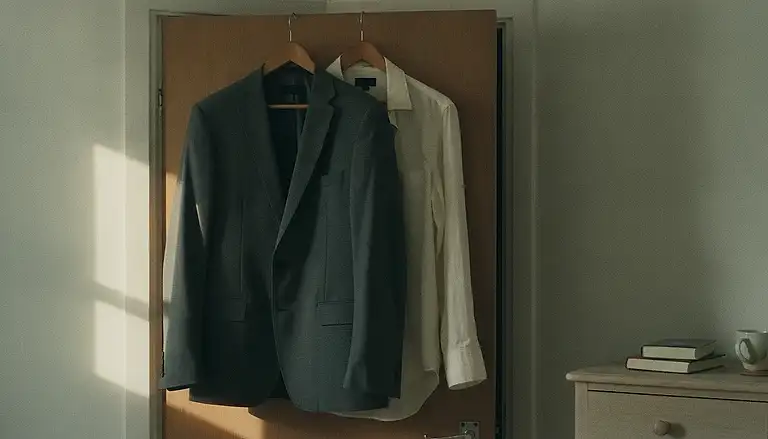

Most advice on how to start over after divorce stops at the practical rebuild: the flat, the work, the sleep, the children’s routine. That part is genuinely hard and it is also the part people manage. The stranger stretch begins later, when someone new is standing in the middle of the life you just reassembled.
How to start over after divorce is usually a question about that later stretch rather than about the ending itself. This page stays with it: not the divorce as an event, but the crossing into whatever comes after, and why the crossing is rarely as clean as the decision to make it.
How do you start over after divorce when a new relationship is the next step?
You mostly do it by allowing someone to matter before you feel safe about it. There is no preparatory stage that removes the risk first, which is what makes the advice to “heal before you date” so difficult to act on.
What people describe is a gap between two clocks. The practical rebuild is the visible half: the flat, the work, the sleep, the children’s routine. It resumes at one pace, while the willingness to be known again moves at another, usually slower and less obedient. Being functional is not the same as being available.
Writing for couples has spent a long time on that second clock. Sue Johnson’s Hold Me Tight is a general-reader book about how adults reach for a partner’s availability and what arguments do to it — a vocabulary, not an assessment of anyone’s relationship.
The tension shows up in small refusals rather than large ones: not introducing someone to friends, for instance, or keeping a spare set of plans, or talking about the future in a careful, provisional tense. None of that is dishonesty; it is a person keeping an exit visible while they work out whether they need it.
Two clocks
What starting over looks like from outside, and from inside
Neither column is the accurate one. Most people are in both at once, which is why the question gets answered badly by other people.
What it looks like from outside
Friends, family, and the person you are dating
Life back in order, so presumably ready. The house works, the job holds, the children have a routine.
Interest in someone new read as evidence that the past is settled.
Hesitation read as a verdict on the new relationship, rather than as leftover weather from an old one.
What it feels like from inside
The version rarely said out loud
Wanting the relationship and flinching at what it would cost to lose one again.
Grief that ignores the timetable and shows up at ordinary moments, sometimes for a marriage you wanted out of.
Suspicion of your own judgement, which is quieter and more corrosive than suspicion of the new partner.
Why am I struggling to move on from my divorce?
Frequently because “moving on” is being measured against the wrong thing. The expectation is that the feeling recedes steadily. Struggling to move on from divorce is the name that expectation gives to something quite ordinary: a feeling that changes shape and returns out of order, mixed with relief in ways that feel disloyal to both.
There is also a structural reason that has nothing to do with willpower. Where children, money, or a shared history with the same friends exist, the ex is not a memory being processed. They are a person who texts about a school pickup. Moving on, in the sense of putting someone behind you, is not on offer.
A third version is quieter. Some of what is hard to leave is not the ex at all but the life that came with the marriage: the shape of the week, the assumed future, the person you were inside it. That loss can outlast any feeling about the individual.
None of these mean something has gone wrong. They mean the word “moving on” describes a tidier process than the one anybody is actually in.
Does starting again after divorce mean you’re ready for someone new?
Not automatically, and readiness is not something this site tests. A quiz cannot see your relationship, and a scored result would only give you a number to argue with.
What can be looked at is more ordinary. Whether the marriage that ended can be named in conversation without an argument starting. Whether disagreements with the new person reach an end rather than a stalemate. Whether you can say what you need without first rehearsing how it will be received.
There is a difference worth keeping between doubt and dread. Doubt asks specific questions and can be answered by evidence over time. Dread does not take answers, returns each night, and gradually removes appetite, sleep, and interest in things that used to hold you.
Where what you have is closer to dread, more private deliberation is unlikely to shift it. That belongs with a professional. The nearby fear of committing again is covered separately in fear of getting married again.
What do you tell someone new about the marriage that ended?
Enough that nothing shaping your present life arrives as a surprise later, such as children, ongoing contact with an ex, money still entangled, or a subject that reliably lands badly in arguments. Those reach into the new relationship whether or not they are mentioned.
The full account is a different matter and is not owed early. Some people describe front-loading the whole history as a form of vetting, and then feeling exposed with someone who has not yet earned it.
The harder part usually runs the other way. Hearing your partner’s version of their own divorce without cross-examining it is difficult, particularly if their ex is an active presence. The pull to compare is its own subject and is covered in being compared to an ex.
What tends to be more useful than the volume of disclosure is its specificity. “I withheld things until it was too late” is information a new partner can work with. “My marriage was a disaster” is a mood, and it invites the other person to reassure rather than understand.

How does starting over change when children are involved?
It slows down and it acquires an audience. A new relationship is no longer a private matter between two adults; it becomes something a child will eventually be told about, and children have reactions that may have nothing to do with liking the person. A child may be perfectly warm with a new partner, for example, and furious about a rearranged Saturday.
Timing decisions about introductions are among the ones parents raise, and they are also the ones no article can make. Households differ in the age of the children, how the separation went, and what the other parent is doing. This site does not issue directives about anyone else’s child.
What often gets skipped is the negotiation between the two adults about what they are building, which is separate from the logistics of schedules and houses. Both exist; only one of them keeps people awake.
Where the household strain has already started — a stepchild who wants no part of it, a partner caught between people — a family therapist who works with blended families is the appropriate route rather than a reading list. That is family work rather than reading, and it belongs with a clinician who takes both households as the unit.
What this page won't do
The starting-over category is full of confident instructions aimed at people in a bad month. Here is what we leave alone, and why.
- Tell you when to date again
- The waiting periods that circulate online are folklore. They are stated with confidence because confidence is what gets shared, not because anyone measured your situation.
- Score your readiness
- No quiz can see your relationship. A result would only give you something to argue with, and it would carry the authority of a number it hasn't earned.
- Diagnose you or your ex
- We describe patterns people report. We do not label the mental health of anybody, least of all a person we have never met and are hearing about from one side.
- Promise a timeline
- This site publishes no figures on how long grief, trust, or a second relationship takes, because none of them would be about you.
What we will do
- Name the ordinary version
- Describe what people in this position commonly report, including the parts that feel disqualifying and are not.
- Separate feelings from decisions
- Missing an ex is a feeling. Ending a relationship is a decision. The first is not automatically instructions for the second.
- Say where the article stops
- Some of this needs a therapist, a doctor, or your own clergy. We say so rather than filling the gap with encouragement.
Is it normal to still miss your ex in a new relationship?
It is commonly described, including by people relieved the marriage is over. Missing a particular person, missing the shape of the life, and missing who you were inside it are separate feelings that tend to arrive together and get filed under one name.
The mistake people describe regretting is treating that feeling as a verdict. A memory that surfaces during an ordinary evening is not a message about the person sitting across from you. It is a memory.
The version that is worth attention is different: not the feeling itself, but a pattern of using the new relationship to conduct unfinished business with the old one. Comparing rather than meeting. Testing rather than asking. Looking for the moment the new person confirms what the last one proved.
Where that pattern is running, it usually needs a conversation rather than a resolution reached alone — with the partner, or with a therapist, or both.
Can you trust someone again after a marriage ended badly?
Many people do, and what they describe is not a single decision but a slow re-gathering of evidence. Trust after a marriage ended badly is assembled from small checkable pieces rather than granted in one act of faith at the start.
The part that lingers is often not suspicion of the new partner but doubt about your own reading of people. That doubt is not repaired by the new person behaving well; it is a separate injury and it frequently needs its own attention.
Accounts of how adults differ in what they expect from closeness draw heavily on Kim Bartholomew and Leonard Horowitz’s four-category model of adult attachment, which sets out styles for describing people rather than verdicts about particular relationships.
The mechanics of this are the subject of their own page, how to trust again after divorce, and the wider set of doubts sits in the feelings hub.
Where this page stops
This page describes what people in this position describe, and what they describe helping. It does not assess you, your partner, or anybody’s ex, and it cannot tell you whether to stay, leave, date, or wait.
If the low stretch has become constant, if you cannot sleep or eat, if the future has gone dark, or if you have thoughts of harming yourself, that is beyond what an article can hold. Speak with a doctor, a therapist, or a helpline in your country.
If you feel unsafe with a current or former partner, that is not a feelings question and it is not something to manage alone. Contact local support services or emergency services where you are.
And where the difficulty is a conflict of faith rather than of feeling — whether this new relationship is one your tradition recognises — the person to sit with is your own priest, pastor, rabbi, or imam. Where that conflict is pressing on your mental health, both conversations are worth having.